Summary
Scientists in China have developed a groundbreaking way to turn dry desert sand into productive soil in just 10 months. By using tiny organisms called cyanobacteria, researchers created a biological crust that holds sand together and retains moisture. This discovery could change how the world fights desertification and help create new land for farming. It offers a much faster solution than natural processes, which usually take hundreds of years to form healthy soil.
Main Impact
The most significant impact of this research is the speed at which it works. Turning a wasteland into a place where plants can grow usually takes a lifetime, but this new method shows results in less than a year. This technology helps stop the spread of deserts, which is a major problem for many countries. By stabilizing the sand, it prevents dust storms and allows for the growth of grass and small plants, eventually making the land useful for humans and animals again.
Key Details
What Happened
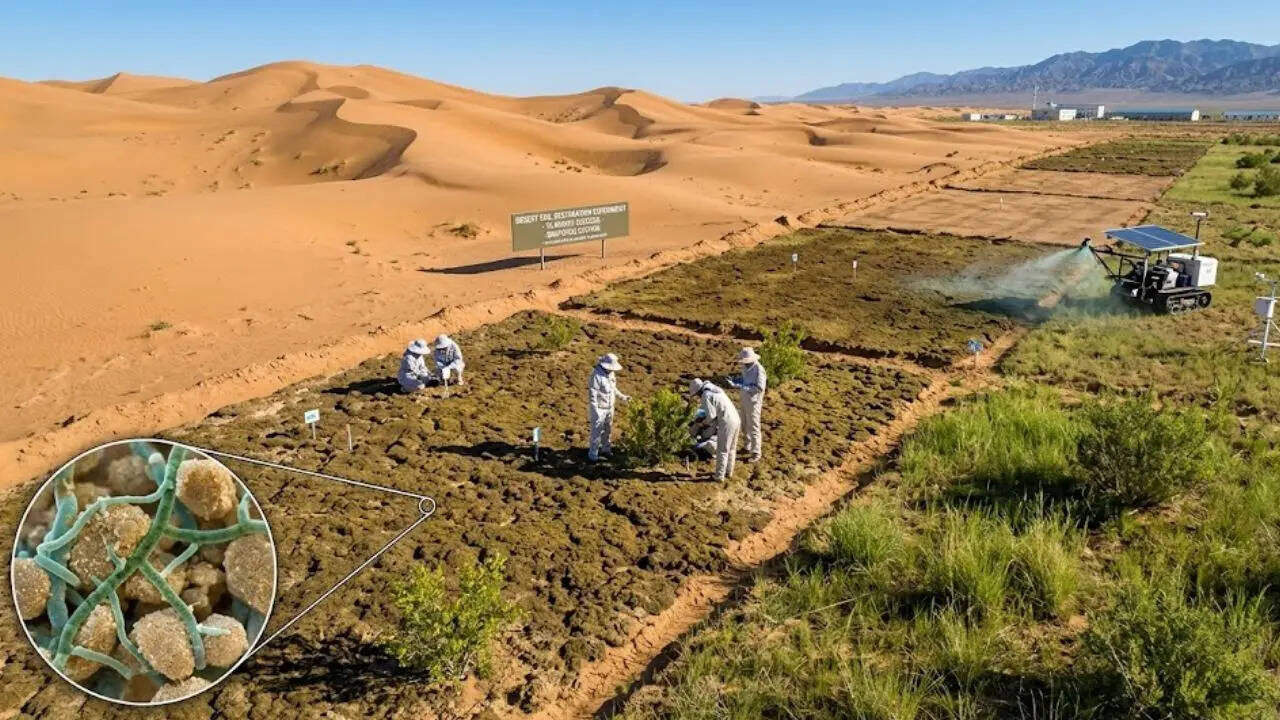
Researchers from the Chinese Academy of Sciences focused on using "biocrusts" to fix the desert. They took cyanobacteria, which are tiny living things that can produce energy from sunlight like plants do. They mixed these organisms with water and sprayed the liquid over large areas of desert sand. Once applied, the cyanobacteria began to grow and produce a sticky substance. This acted like a natural glue, binding the loose sand particles together into a solid layer.
This layer, or crust, performs several important jobs. It keeps the sand from blowing away in the wind and helps the ground hold onto rainwater instead of letting it sink deep into the earth where plants cannot reach it. Over time, as the bacteria live and die, they add nutrients to the sand, slowly turning it into real soil.
Important Numbers and Facts
The project showed that the sand started changing its structure almost immediately. Within 10 months, the top layer of the desert became firm enough to support small plants. In testing areas, the amount of organic matter in the sand increased significantly. This is important because organic matter is what makes soil fertile. The researchers also found that the crust reduced the amount of water lost to evaporation by a large margin, making the environment much more friendly for life.
Background and Context
Desertification is a process where fertile land becomes a desert, usually because of climate change or poor farming habits. It is a global crisis that threatens food supplies and forces people to leave their homes. China has been fighting this problem for a long time because large parts of its northern territory are covered by deserts like the Gobi and the Kubuqi.
In the past, people tried to stop deserts by planting millions of trees. While this helped, trees require a lot of water, which is hard to find in a desert. If the trees die, the sand starts moving again. This new method using cyanobacteria is different because it works with the sand itself. It creates a foundation that allows nature to take over. It is a more natural and sustainable way to fix the land without needing constant human help or massive amounts of extra water.
Public or Industry Reaction
The scientific community has reacted with great interest to these findings. Experts in agriculture and environmental science see this as a low-cost way to repair damaged ecosystems. Many believe that this method is better than using chemical sprays or plastic covers to hold sand in place, as those can hurt the environment. People living near desert regions are also hopeful, as this technology could lead to fewer dust storms and better air quality in their cities.
What This Means Going Forward
The next step for this technology is to see if it can work in different types of deserts around the world. Every desert has different temperatures and types of sand, so the researchers need to make sure the cyanobacteria can survive in various conditions. If successful, this could be used on a massive scale to reclaim land in Africa, the Middle East, and Australia.
There is also the possibility of using this soil for farming. While the first 10 months create a base for grass, longer periods of treatment might make the land strong enough to grow crops like corn or wheat. This would be a major win for global food security as the world population continues to grow.
Final Take
This breakthrough shows that small organisms can solve some of our biggest environmental problems. By working with nature instead of against it, scientists have found a way to breathe life back into the sand. This 10-month transformation is a sign of hope for a greener future and a more stable climate.
Frequently Asked Questions
What are cyanobacteria?
Cyanobacteria are tiny, single-celled organisms that live in water or moist soil. They are often called blue-green algae and can make their own food using sunlight, just like plants.
Is the new soil safe for the environment?
Yes, the process uses natural organisms that are already found in many environments. It does not use harsh chemicals, making it a safe way to restore land.
Can you grow food in this desert soil right away?
While the soil becomes stable in 10 months, it usually starts by supporting simple plants like moss and grass. It may take more time and additional nutrients before it is ready for large-scale food farming.