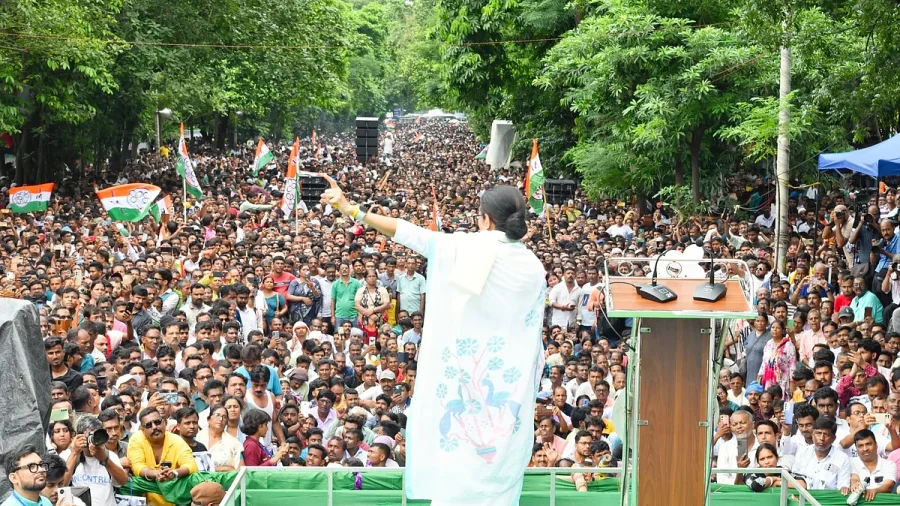
Thirty-three monsoons after Mamata Banerjee first led a march demanding voter photo identity cards, the same Election Commission that adopted her idea has now disenfranchised 27 lakh voters in West Bengal. And yet, on 21 July 2025, as she stood on the Brigade Parade Ground podium, the sea of green flags and roaring chants suggested one thing clearly: Didi remains the undisputed crowd puller, and the rebels who broke away are yet to matter.
A rally born from sacrifice, now a testament to endurance
The Shahid Divas rally commemorates 13 Youth Congress workers shot dead by Kolkata Police in 1993 during a protest for electoral reforms. Over the years, it has become TMC’s annual show of strength. This year, it was also a response to those who wrote off Banerjee after a string of defections and the EC’s aggressive voter list revision.
Why the 21 July rally matters beyond numbers
For Bengali voters, the rally is not just a political spectacle – it is a measure of who holds the pulse of the state. A visibly large turnout signals that Banerjee’s grassroots machinery is intact and that the rebel faction led by former TMC heavyweights has failed to carve a meaningful space. Political analysts note that in a state where street power translates into electoral heft, Didi’s ability to fill the ground matters more than opinion polls.
From reform demand to victim of reform: the EC irony
It was Banerjee’s 1993 rally that pushed for photo identity cards to curb voter fraud. Three decades later, the EC – now armed with the very tool she demanded – has removed millions of names from Bengal’s rolls, citing duplication and ineligible entries. Banerjee has alleged a political conspiracy to shrink her voter base. The 21 July rally therefore carried a dual message: defiance against the EC and a claim to moral high ground.
Who is affected by the rebel challenge?
Internal dissidents like Mukul Roy and others who left TMC in recent years have tried to position themselves as alternative leaders. But the rally’s turnout suggests that at the ground level, their influence remains negligible. For ordinary party workers and voters, Didi’s personal connect and welfare schemes still trump factional loyalties. The rebels, for now, appear irrelevant in the broader narrative of Bengal politics.
Official response from the Trinamool leadership
Senior TMC leaders claimed the rally was the largest in recent years. “The people have given their answer to those who thought Didi was finished,” a party spokesperson said, without naming the rebels or the EC. The party also highlighted that volunteers from all 294 assembly constituencies attended, indicating intact organisational reach.
Deeper analysis: why the crowd matters more than polls
The 21 July crowd is not just a photo opportunity. It reflects the party’s ability to mobilise resources, transport, and loyal cadres across districts. In a state where political power is often contested on the streets, a visible show of strength can deter potential defections and attract fence-sitters. The rally also serves as a psychological boost before local body elections, which are due later this year.
Confirmed facts vs what remains unclear
Confirmed: The EC has removed 27 lakh voters from Bengal’s rolls; TMC’s 21 July rally did draw a large crowd; the rally commemorates the 1993 police firing. Unclear: Exact crowd size (independent verification is difficult); whether rebel groups held any competing events; the extent to which the EC action will affect future electoral outcomes.
Company moat – Mamata Banerjee’s political brand
Banerjee’s political strength is built on a unique combination: a regional party with deep roots, welfare schemes like Kanyashree and Sabuj Sathi that create direct beneficiary loyalty, and her personal image as a fighter who endured police brutality in 1993. This emotional bond with voters is her moat – hard for rebels or national parties to replicate.
Risks and balanced view
Despite the rally’s scale, challenges remain. The EC’s voter list revision could disenfranchise key TMC support bases. Rebel leaders may still cause damage in localised pockets. The party also faces anti-incumbency in some urban areas. Critics argue that crowd size does not always translate into votes, especially when administrative machinery is controlled by opponents.
Wider trend – regional satraps rallying against central agencies
Banerjee’s confrontation with the EC is part of a larger pattern where regional parties in opposition-ruled states accuse the Centre of using investigative and electoral agencies to target rivals. Similar tensions have played out in Delhi, Punjab, and Tamil Nadu. The 21 July rally is thus also a symbol of resistance against perceived federal overreach.
Practical guidance for voters and political observers
Voters should check their names on the electoral roll before the next major election. Political watchers should track local body polls as a more granular test of TMC’s ground strength. For investors and businesses, Bengal’s political stability matters – a weakened Banerjee could lead to policy uncertainty.
Future outlook
If the EC and state government do not resolve the voter list dispute, the next assembly election may be contested on a distorted roll. Banerjee is likely to keep the 21 July rally as a permanent fixture. Rebel leaders may either merge back or fade further. The coming months will test whether the crowd puller can also become a vote puller without the usual electoral machinery.
Our take
The 21 July rally reaffirms that Mamata Banerjee remains the dominant political figure in West Bengal. However, the real test lies in the booth – not the podium. The EC’s voter list action is a structural challenge that no rally can solve. For the TMC, the task ahead is to combine mass mobilisation with administrative vigilance. For the rebels, the evidence suggests they have a long, hard road ahead before they can claim relevance.
Frequently Asked Questions
Why is the 21 July rally important for Mamata Banerjee?
The 21 July Shahid Divas rally is TMC’s annual show of strength, commemorating activists killed in 1993. It serves as a barometer of party unity, organisational reach, and Banerjee’s personal popularity ahead of elections.
What is the controversy around the EC and Bengal’s voters’ list?
The Election Commission removed 27 lakh names from West Bengal’s electoral roll, citing duplication and ineligible entries. Banerjee claims it is a politically motivated move to reduce her voter base, a charge the EC denies.
Are the rebels a serious threat to Mamata Banerjee?
Based on the 21 July rally turnout, rebel groups have not made a significant dent in Banerjee’s mass appeal. Their influence appears limited to a few constituencies and among disgruntled ex-leaders, not the grassroots.
What does the rally mean for Bengal’s next elections?
The rally boosts TMC’s morale but does not guarantee electoral success. The actual test will be in local body polls and how the voter list issue is resolved. It signals that Banerjee retains core support, but administrative challenges could complicate future results.