
Summary
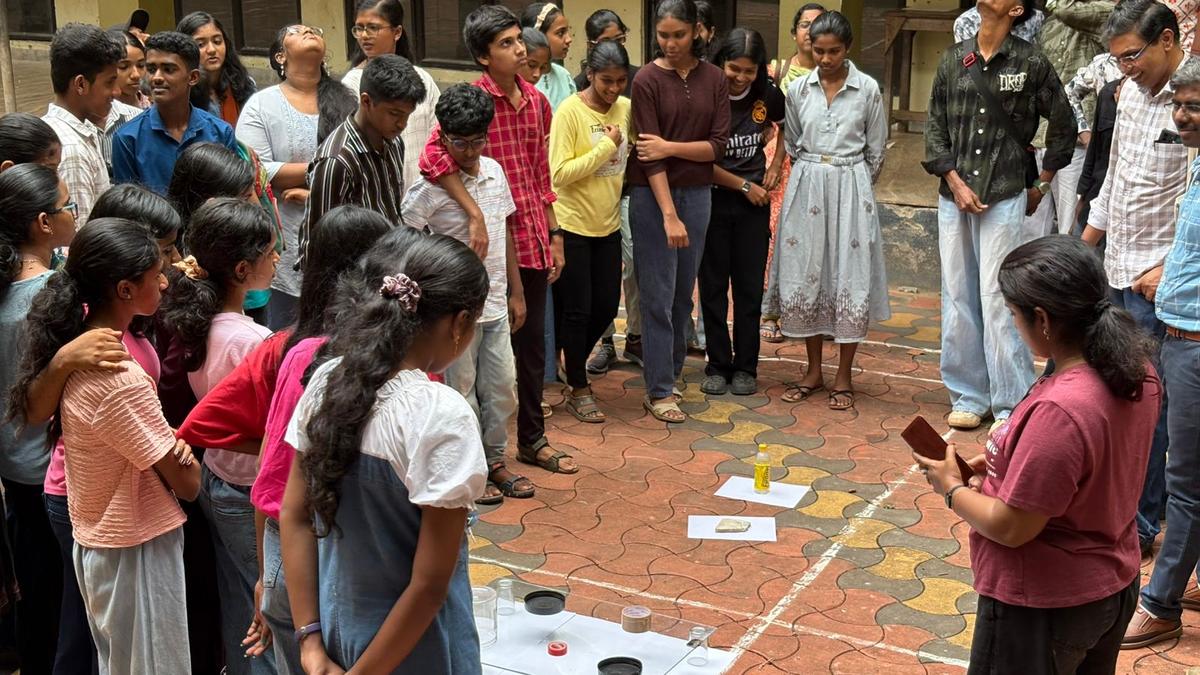
Students at a local summer science camp recently gathered to witness a rare and exciting event called Zero Shadow Day. The event took place at the Government College in Attingal, where young learners participated in hands-on activities to understand why shadows disappear at a specific time. By observing the sun’s position, the students learned about the movement of the Earth and how it affects our daily lives. This educational session turned a complex scientific idea into a fun and memorable experience for everyone involved.
Main Impact
The primary impact of this event was the way it simplified difficult space science for young children. Instead of just reading about the sun in a textbook, students saw the science happen right in front of them. This type of practical learning helps spark a deep interest in science, technology, engineering, and math. By hosting this at a government college, the community showed that high-level scientific concepts can be made accessible to students from all backgrounds.
Key Details
What Happened
During the Summer Science Camp at Government College, Attingal, organizers set up a special demonstration for Zero Shadow Day. As the clock moved toward local noon, students placed vertical objects like sticks, pipes, and bottles on a flat surface. They watched closely as the shadows of these objects grew shorter and shorter. At the exact moment the sun reached its highest point in the sky, the shadows completely vanished. The students were able to see that for a few minutes, the sun was perfectly overhead, leaving no room for a shadow to fall on the ground.
Important Numbers and Facts
Zero Shadow Day does not happen everywhere at the same time. It only occurs in places located between the Tropics of Cancer and Capricorn. Because the Earth is tilted at an angle of about 23.5 degrees, the sun’s path changes throughout the year. In Attingal, this event happens twice a year as the sun appears to move north and then back south. The students learned that this phenomenon is a direct result of the Earth’s tilt and its orbit around the sun. The event lasted only a few minutes, but the preparation and lessons surrounding it took several hours of the camp day.
Background and Context
To understand Zero Shadow Day, one must understand how our planet moves. Most of the time, the sun is either a little bit to the north or a little bit to the south of where we are standing. This causes shadows to lean in one direction. However, twice a year, for people living in certain parts of the world, the sun passes exactly over their heads. This is often called the "subsolar point." Science camps use this day to teach kids about the seasons, the rotation of the Earth, and how ancient people used the sun to tell time and navigate the world.
Public or Industry Reaction
Teachers and parents have praised the organizers of the Summer Science Camp for including such a practical lesson. Many educators believe that seeing a phenomenon in person is much more effective than watching a video or looking at a diagram. Local residents also showed interest, with some stopping by to see the demonstration. The success of the event has led to calls for more outdoor science activities in schools across the region. Experts in education say that these moments of wonder are what lead students to pursue careers in research and astronomy later in life.
What This Means Going Forward
The success of the Zero Shadow Day event at Attingal suggests a growing trend in interactive education. Moving forward, more schools are likely to plan their science lessons around natural events. This helps students connect what they learn in the classroom with the world around them. It also highlights the importance of summer camps in keeping children engaged during their school breaks. As technology continues to change how we learn, simple experiments using the sun and a stick remain some of the most powerful ways to teach the basics of physics and astronomy.
Final Take
Zero Shadow Day is more than just a cool trick of light; it is a clear reminder of our place in the solar system. By bringing students together at Government College, Attingal, the camp organizers proved that science is best learned through curiosity and observation. When a child sees a shadow disappear, they start asking questions about why it happened, and those questions are the foundation of all great scientific discoveries.
Frequently Asked Questions
What exactly is Zero Shadow Day?
It is a day when the sun is exactly at its highest point in the sky at noon. Because the sun is directly overhead, vertical objects do not cast a shadow on the ground for a few minutes.
Does Zero Shadow Day happen everywhere?
No, it only happens in places located between the Tropics of Cancer and Capricorn. People living far north or far south of the equator will never experience a total Zero Shadow Day.
Why does it happen twice a year?
It happens twice because the sun appears to move from south to north and then back again as the Earth orbits the sun. This means the sun passes directly over the same spot twice during its yearly cycle.



