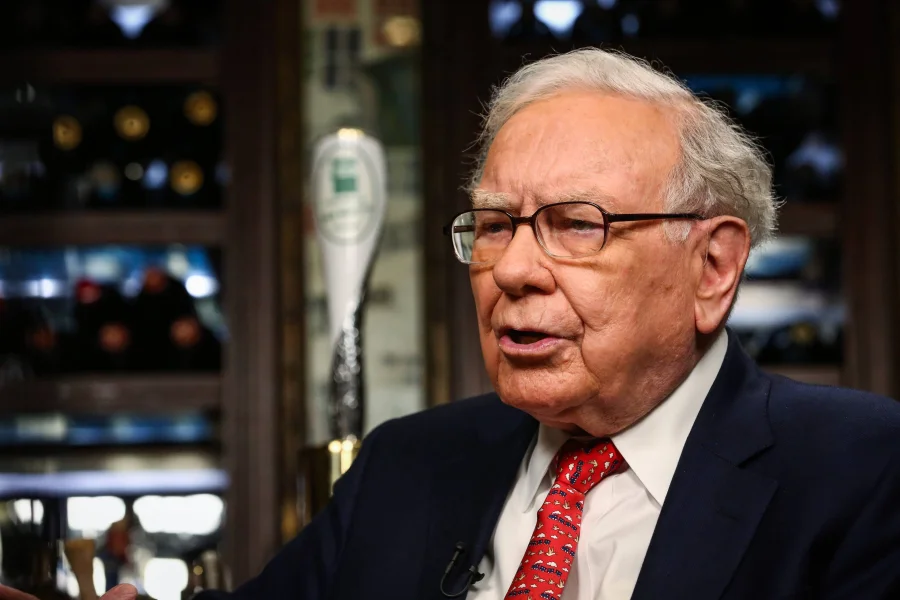
Every few months, Warren Buffett says the same thing, and every few months, the investing world pretends it's hearing it for the first time: buy the broad marke...
Admin
The Tasalli
728 x 90Header Slot
TL;DR — Quick Summary
Warren Buffett has spent decades pointing ordinary investors to the same simple tool: a low-cost S&P 500 index fund or ETF. His 10-year public bet against a basket of hedge funds ended with the index winning comfortably. For most people, his logic — low fees, broad ownership of American business, and patience — remains the most reliable playbook in investing.
Key Facts
**Main Update
** In repeated shareholder letters and interviews, Buffett has advised non-professional investors to buy a low-cost S&P 500 index fund instead of individual stocks or actively managed funds.
**The Bet
** His 2007–2017 wager with Protégé Partners pitted a Vanguard S&P 500 index fund against five hedge-fund-of-funds; the index won the decade. The results were disclosed in Berkshire Hathaway's 2017 annual letter.
**Inheritance Advice
** In his 2013 letter, Buffett wrote that 90% of the cash left for his wife should go into a low-cost S&P 500 index fund, with 10% in short-term government bonds.
**Core Logic
** Minimal fees, broad diversification, and the long-term growth of American business are the three pillars of his repeat advice.
**No Single Ticker
** Buffett does not endorse one ETF brand. Financial media and investors most often use SPY, VOO, or IVV as practical stand-ins for "the same ETF."
**Risk Balance
** Index funds remove stock-picking risk, not market risk. Periods like 2000–2009 produced flat returns, and panic selling is the real danger for most holders.
Every few months, Warren Buffett says the same thing, and every few months, the investing world pretends it's hearing it for the first time: buy the broad market, keep costs low, and don't try to outsmart Wall Street. He has pointed at the same S&P 500 index fund or ETF for years. The repetition is not laziness — it's the message.
The Bet That Made This Advice Hard to Argue With
In 2007, Buffett made a public wager with Protégé Partners, a hedge fund firm. He bet that a simple, low-cost S&P 500 index fund would beat a handpicked basket of hedge funds over ten years. The loser would donate $1 million to charity.
The index won. Berkshire Hathaway's 2017 annual letter, which documented the result, became one of the most cited documents in modern investing. The lesson Buffet drew: after fees, the simplest product beat some of the most expensive talent on Wall Street.
Why the Same Index? The Math of Fees and Compounding
Buffett's argument is not about intelligence — it's about arithmetic. Most S&P 500 index funds charge between 0.03% and 0.09% a year. Many active funds charge more than ten times that, and hedge funds typically take 1% to 2% in management fees plus a cut of profits.
Over 20 or 30 years, those fees compound against the investor. Over the same stretch, the index compounds for the investor. Buffett's point is that you don't need to pick the next Apple — you just need to own all of American business and stand still.
The Deeper Reason: It's a Bet on America Itself
Buffett has been publicly bullish on American business for most of his life. The S&P 500, in his framing, is not merely a collection of 500 companies. It is a claim on the innovation, earnings, and resilience of the world's largest economy.
That worldview explains why he repeats himself. He is not predicting next quarter. He is expressing a long-term conviction that American capitalism, despite its crises and bubbles, has consistently created wealth for patient owners. Index investing is the simplest way to capture that.
Who This Advice Is Really For
This guidance is aimed squarely at people who do not run money for a living. Buffett himself does not invest this way — Berkshire Hathaway owns concentrated stakes in select businesses. But he has repeatedly said that for nurses, teachers, engineers, and doctors, stock-picking is a losing game.
In his 2013 letter, he wrote that most investors are better off owning a low-cost S&P 500 index fund. He even instructed that most of the inheritance he leaves for his wife be placed in one. That is as personal as his public advice ever gets.
Confirmed Facts vs What Remains Unclear
**Confirmed from Berkshire's public letters:** Buffett's 10-year bet with Protégé ended in the index fund's favour; his estate instructions include a large allocation to a low-cost S&P 500 index fund; and he has consistently steered everyday investors toward index funds.
**Still unresolved:** There is no single "Buffett ETF" ticker — the financial media assigns that label loosely. Whether the rise of index funds is distorting stock prices is also an active debate among economists. And past US stock performance does not guarantee future returns.
The Case Against It: When Index Investing Hurts
An S&P 500 index fund offers no protection in a crash. Investors who bought in 2000 saw no net gain for nearly a decade. The index is also heavily concentrated — in recent years a handful of technology stocks have driven a large share of its returns, which means "broad diversification" can feel narrower than it sounds.
There is also a behavioural problem. The fund works only if the owner stays invested. Many investors sell at the bottom, lock in losses, and then blame the index — when the real failure was their own panic. Buffett's advice assumes a calm stomach most people do not have.
What Investors Should Actually Do
The practical version of Buffett's advice is simple: invest regularly through good years and bad, choose a fund with an expense ratio below 0.10%, and do not check the portfolio every morning.
For Indian readers, the same logic applies locally — low-cost Nifty 50 index funds use an identical fee-and-diversification argument. International exposure to the S&P 500 is also available through feeder funds and US-focused ETFs, though currency risk adds a layer Buffett does not worry about as an American investor.
The Wider Trend: The Era of Passive Investing
Buffett's repeated advice has coincided with one of the biggest shifts in financial history. Trillions of dollars have moved from active managers into index funds. Fees have collapsed. The index has become the default benchmark — and increasingly, the default investment.
Critics