
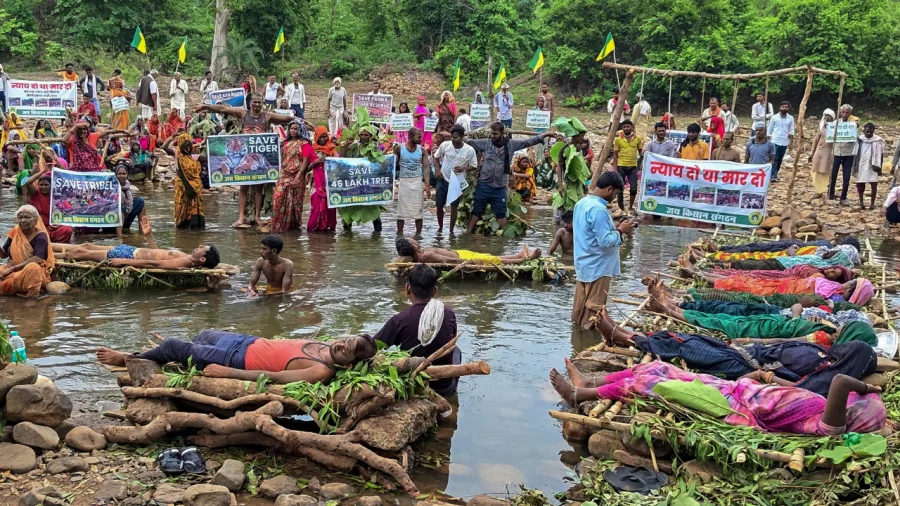
Decades after their ancestors set fire to forest produce in the Chita Andolan to protest British forest laws, the Gond and Bhil communities of Bundelkhand are mobilising again. This time, the enemy is the Ken-Betwa river linking project — a ₹44,000-crore infrastructure plan that they say will drown their ancestral lands, break their villages, and violate the Forest Rights Act.
The Heart of the Anger: Displacement and the Panna Tiger Reserve
The Ken-Betwa project proposes a dam on the Ken river near Daudhan village in Panna district. It will flood 8,100 hectares of the Panna Tiger Reserve — a critical tiger habitat that was restored from near-extinction in the early 2000s. Tribals living inside the reserve have long been denied land titles under the Forest Rights Act, making them vulnerable to eviction without due process.
Activists say the total displaced population could exceed 2.5 lakh, with families from 155 villages directly affected. Many belong to the Gond, Bhil, and Kol tribes, who have inhabited these forests for centuries.
"Chita Andolan" to "Jal Satyagraha": Two Centuries of Resistance
The Chita Andolan of 1930-31 saw Gond tribals in Central Provinces (now MP) torch timber depots and forest produce to protest British forest laws that criminalised their traditional livelihoods. It was a movement of the desperate. Today, their descendants are turning to non-violent water rights protests — Jal Satyagrahas — modelled after the Narmada Bachao Andolan of the 1990s.
Chetna Dharkar, a community leader from Panna, explained in a recent interview, "Our fathers burned the forest because they were denied its fruits. Now they want to drown the forest for 'development'. We will sit on the riverbed if needed." The tactic of Jal Satyagraha — physically blocking the river to halt dam construction — was famously used by anti-dam activists in the Narmada valley. Tribals in Bundelkhand are now preparing the same.
Why the Project is Going Ahead
Proponents argue that the project is a lifeline for Bundelkhand, a region that regularly faces droughts. The National Water Development Agency (NWDA) claims it will irrigate 6.35 lakh hectares of agricultural land and generate 62 MW of hydropower. The Madhya Pradesh government calls it a "transformative" step for the region's water security. The Union Budget 2024-25 allocated ₹1,440 crore for river-linking schemes, including Ken-Betwa.
Yet, critics point out that the cost-benefit analysis has not been updated for inflation or ecological damage. A 2023 report by the Indian Institute of Forest Management (IIFM), Bhopal, warned that dam-induced fragmentation of the Panna landscape could reverse tiger conservation gains.
Who is Affected and Why It Matters to Ordinary Indians
Beyond the tribal communities, the project affects every Indian who cares about wildlife, water justice, and constitutional rights. The Panna Tiger Reserve was celebrated as a conservation success story — its tiger count went from zero in 2009 to 50 in 2022. Submerging a tenth of its habitat could trigger a second extinction event.
For millions in urban India, the Ken-Betwa story is a reminder that large infrastructure projects often ignore the voices of the poorest. "We are not against development," said Sunilam, a Gond activist from Chhatarpur. "But development should not mean our homelessness."
Official Response and Legal Wrangle
The Ministry of Environment issued a "Stage I" forest clearance in 2023, subject to the project obtaining wildlife clearance from the National Board for Wildlife (NBWL) and compliance with the Forest Rights Act (FRA). So far, the FRA-mandated Gram Sabha consent — required from every affected village — has not been fully completed. Tribal rights groups have filed a petition before the National Green Tribunal (NGT), arguing that the clearance is illegal without Gram Sabha consent. The NGT issued a notice to the government in July 2024, with the next hearing expected in April 2025.
Confirmed Facts vs What Remains Unclear
Confirmed: The project will submerge 8,100 hectares in Panna Tiger Reserve (MoEFCC submission). 155 villages face displacement (NWDA data). The Forest Rights Act requires Gram Sabha consent, which has not been obtained in all affected villages (NGT petition). The Chita Andolan and Narmada Jal Satyagraha are historical precedents.
Unclear: Whether the government will modify the project design to minimise displacement. Whether the NGT will order a fresh environmental impact assessment. How much land the tribals actually hold legal titles to under the FRA — many claims are pending.
The Political and Economic Stakes
The Ken-Betwa project is the first under India's ambitious National River Linking Project (NRLP), which aims to connect 14 Himalayan and peninsular rivers. A delay or cancellation here could set a precedent. Pro-big dam lobbies and many farmers in irrigated areas support the project; environmentalists and adivasi groups oppose it. The state government of Madhya Pradesh is keen to show progress, while the Union government has made river-linking a policy priority.
Risks and Balanced View
On one hand, improved irrigation could reduce distress migration and suicides among farmers. On the other, the displacement of tribals without proper rehabilitation could lead to deeper poverty. Studies by the Tata Institute of Social Sciences indicate that 40% of displaced families from large dams in India remain landless and impoverished even two decades after relocation. The biggest risk is that the government bypasses the FRA — a move that may be challenged in court and could trigger violent protests.
The Wider Pattern: River-Linking and Tribal Rights
The Ken-Betwa conflict is part of a larger national debate. From the Polavaram project in Andhra Pradesh to the Par-Tapi-Narmada link in Gujarat, tribal communities are being asked to sacrifice their homes for "national good." The difference now is that courts are increasingly recognising the FRA and the right to free, prior, and informed consent (FPIC). Would the Ken-Betwa case become a turning point?
Practical Reader Guidance: What Affected Communities Can Do Now
Tribals in project-affected villages should document their forest rights claims under the FRA, approach the appointed gram sabha convener, and participate in all official hearings. Legal help is available through the Human Rights Law Network (HRLN) and local groups like the Bundelkhand Sangharsh Samiti. Those who wish to support can sign petitions or amplify the issue on social media using #KenBetwaJalSatyagraha.
Future Outlook
If the NGT rules in favour of the tribals, the project may be delayed by years or redesigned. If the government wins, construction could begin by 2026, triggering sustained protests. The upcoming Madhya Pradesh assembly elections (2028) could also influence the political will. Meanwhile, the Jal Satyagraha plans are being prepared for the next monsoon season.
Our Take
The Ken-Betwa project is a classic development dilemma — irrigation for millions versus homes for thousands. But the Constitution gives tribals a right to be heard, not just compensated. The government's failure to secure full Gram Sabha consent is not just a legal lapse; it is a democratic deficit. If India's river-linking dream is to be realised without repeating the mistakes of the Narmada dams, projects must earn the consent of the most affected. Otherwise, the Jal Satyagrahas of today may turn into larger, more painful conflicts tomorrow.
Frequently Asked Questions
What is the Ken-Betwa river linking project?
It is a proposed canal and dam system that will connect the Ken and Betwa rivers in central India. It aims to irrigate drought-prone Bundelkhand and generate hydropower.
Why are tribals protesting against it?
Because the project will submerge 8,100 hectares of the Panna Tiger Reserve and displace over 2.5 lakh people, mostly Gond and Bhil tribals who have lived there for generations. They say their rights under the Forest Rights Act have been ignored.
What is a Jal Satyagraha?
A non-violent protest where activists sit or stand in the river to physically block dam construction or water diversion. It was popularised by the Narmada Bachao Andolan in the 1990s.
What is the Chita Andolan?
A historic protest by Gond tribals in the 1930s where they set fire to forest produce to oppose British forest laws that criminalised their traditional use of forests.



