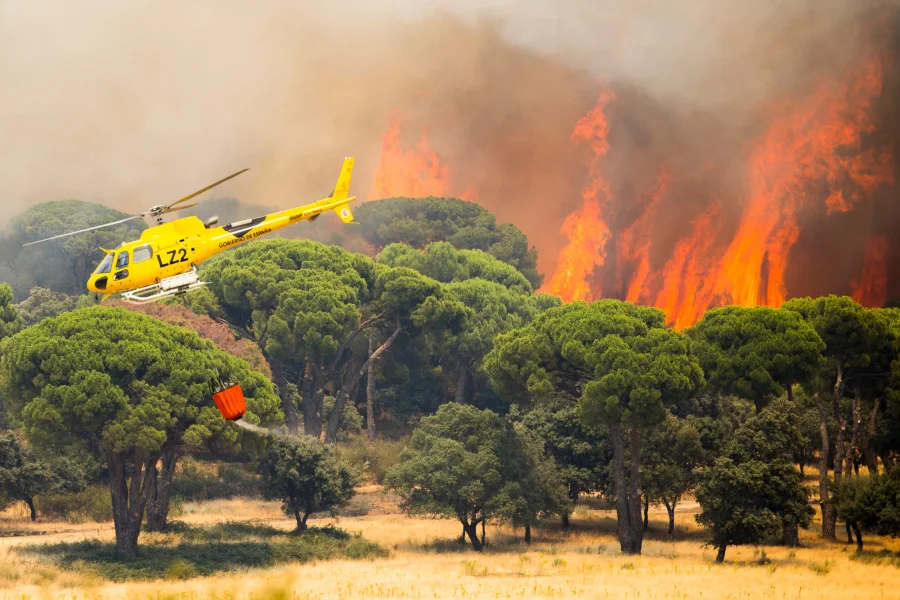
The most destructive wildfire in modern Spanish history continues to rage in Ávila, with Interior Minister Fernando Grande-Marlaska calling it “the most important and aggressive fire Spain has ever faced.” The stark assessment came after an emergency meeting of the Cecod crisis committee at the Advanced Command Post in Navalcarnero.
“More favorable” but agonizingly slow progress
Marlaska told reporters that the fire’s evolution has improved slightly compared to the previous day, but warned that progress is “very slow.” Unfavorable weather conditions — strong winds, low humidity, and high temperatures — continue to challenge the thousands of firefighters and military personnel on the ground.
Devastating scale: 47,000 hectares in Ávila alone
The minister confirmed that 47,000 hectares have been incinerated in Ávila province. However, Ecological Transition Minister Sara Aagesen earlier cited a slightly higher figure of 50,000 hectares in the same area. The discrepancy likely reflects the difficulty of real-time satellite assessment. Nationwide, Aagesen reported that 153,000 hectares have been burned so far in 2022 — six times the area recorded in the same period last year.
Why this fire is unlike any before
The fire’s intensity and speed have overwhelmed containment efforts, pushing it into the record books. Experts point to a combination of extreme drought, record heatwaves, and decades of rural land abandonment that has turned forests into tinderboxes. “We are facing a new reality,” a senior firefighting official told reporters on condition of anonymity.
Human toll and displacement
While no immediate casualties have been confirmed, thousands of residents in affected villages have been evacuated. Emergency shelters have been set up in nearby towns. The psychological impact on communities already traumatized by previous fires is profound, with many families losing homes, livestock, and livelihoods.
Government response: Cecod and military mobilisation
The Cecod meeting brought together senior officials from the Interior Ministry, Ecological Transition, Defence, and regional governments. The military’s emergency unit (UME) has deployed hundreds of troops, along with helicopters and water-dropping aircraft. Marlaska praised the coordination but acknowledged that the fire’s sheer force makes conventional tactics insufficient.
What the numbers mean: comparing to previous disasters
Spain’s deadliest fire prior to 2022 was the 2013 blaze in Guadalajara that killed 11 firefighters. In terms of area, the largest recorded fire before this was the 2012 Valencia fire that burned about 50,000 hectares. The Ávila fire, at 47,000–50,000 hectares, already equals or surpasses that record — and it’s still active.
Confirmed facts vs. what remains unclear
Verified: Marlaska’s statement, the 47,000-hectare figure (with Aagesen’s 50,000 cited as alternative), and the total 153,000 hectares nationwide. The fire’s status as “most aggressive in history” is an official classification.
Uncertain: Exact number of structures destroyed, final acreage (fire still burning), cause of ignition (investigation ongoing), and potential summer rain relief (forecasts uncertain).
Risks and balanced view
While the government’s response has been swift, critics note that successive budget cuts to firefighting services have weakened early-response capability. Environmental groups also argue that decades of poor forest management have exacerbated fire risk. The official line emphasises that the extreme weather is the primary driver, a position supported by climate models.
A wider pattern: Europe’s fire season in a warming climate
The Spanish blaze is part of a catastrophic fire season across southern Europe. Portugal, France, Greece, and Italy have all faced mega-fires in 2022. Scientists warn that climate change is making such events more frequent and intense. Spain’s government has pledged to invest in more firefighting aircraft and a national reforestation plan, but long-term adaptation remains slow.
Practical guidance for affected residents
Evacuation orders should be obeyed immediately. Stay updated through official channels: Protección Civil, UME, and local authorities. For displaced families, regional emergency shelters are open; financial aid applications for lost property can be initiated via the Ministry of the Interior’s online portal. Avoid spreading unverified social media reports.
Future outlook
Marlaska cautioned that the fire could continue for days or even weeks if weather conditions do not improve significantly. Meteorologists predict a possible shift in wind direction, which could either help contain the flames or push them toward new areas. Full containment is not expected before mid-August at the earliest.
Our Take
The “most aggressive fire in Spain’s history” is not just a record – it’s a warning. This crisis underscores that conventional firefighting strategies are no longer sufficient against climate-driven megafires. Spain must now urgently reimagine its approach: from prevention and land management to community resilience. The human cost, still unfolding, will be felt for years.
Frequently Asked Questions
Is the Ávila fire the biggest in Spanish history?
By area, it is one of the largest. Interior Minister Marlaska called it the “most important and aggressive” fire in Spain’s recorded history, referencing both size and intensity.
How many hectares have burned in Spain this year?
According to Ecological Transition Minister Sara Aagesen, 153,000 hectares have been burned nationwide in 2022 – six times more than in the same period of 2021.
What caused the fire?
The exact cause is under investigation. Extreme drought, record heat, and strong winds have contributed to its rapid spread.
Are there any casualties?
No confirmed fatalities have been reported as of the latest official update, but the situation remains dynamic.