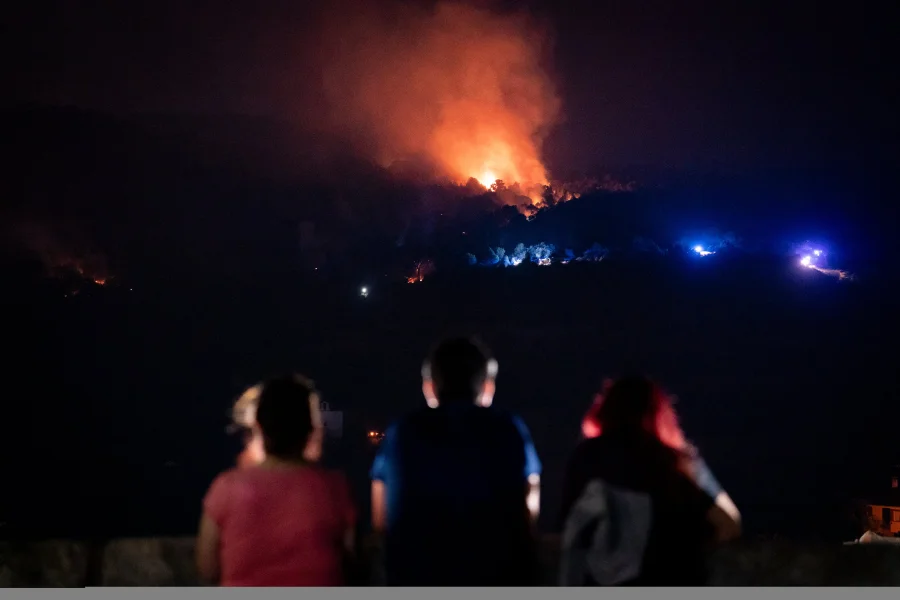
More than 121,000 people have been forced to flee their homes or remain confined as a series of ferocious wildfires tear through central and eastern Spain, incinerating over 45,000 hectares of land. The flames, which have swept across Madrid, Ávila, Toledo, and Castellón, are among the largest to hit the region in recent years.
For thousands of families, the night was spent in shelters, cars, or at emergency reception centres, watching orange glows light up ridges they called home just hours earlier.
Blazes spread across four provinces – Madrid, Ávila, Toledo, Castellón
The largest fire continues to burn in the Sierra Oeste of Madrid, spreading into Ávila and pushing toward Toledo. Firefighters used a brief reduction in wind speed overnight to strengthen containment lines, but the fire remains active and far from controlled, the regional government said.
In Castellón, the fire around Vall d’Uixò has forced additional evacuations, while a separate blaze near Murias de Ponjos, León, led to the evacuation of 20 residents. In Cuacos de Yuste, Cáceres, 16 children at a summer camp were taken to safety.
Why this crisis feels different: scale, speed, and human cost
Evacuations on this scale — 121,000 people — are rare for Spain outside of major floods or volcanic events. The speed at which the flames advanced caught many communities off guard. Roads clogged as families fled with only documents and pets. Elderly residents in rural hamlets were airlifted by helicopter. Officials describe the emergency as “unprecedented in recent decades” for the Madrid region.
A timeline of the unfolding disaster
The fires ignited late last week during an intense heatwave that dried out vegetation and left forests like tinder. By the weekend, multiple fronts had merged into a single crisis. On Monday, the Madrid regional government raised its emergency level to the highest tier, requesting military support. Throughout Tuesday and Wednesday, evacuation orders expanded as the fire jumped containment lines.
Who is most affected — and what it means for residents
Entire urbanisations on the outskirts of Madrid have been emptied. Schools, hospitals and care homes have been closed or relocated. Farmers have lost livestock and olive groves. For the 121,000 displaced, the immediate loss is clear: homes, belongings, livelihoods. The psychological toll is only just beginning.
Many evacuees do not yet know if their homes still stand. Officials have warned that it may be days before all areas can be safely re-entered.
Official response: firefighters gain slight upper hand but no all-clear
“The lower intensity of the fire during the early morning has allowed our crews to act on the different fronts and reinforce control lines,” a spokesperson for the Madrid regional fire service said. “But the fire is still active and not stabilised.” Hundreds of firefighters, supported by the Military Emergency Unit (UME), are working in shifts. Water-dropping aircraft resumed operations at first light.
What is driving these fires — and why experts are worried
Spain has seen a dramatic increase in large wildfires driven by hotter, drier summers linked to climate change. This year’s heatwave arrived early, leaving soil and vegetation moisture at record lows. Fire scientists say that even with robust suppression, extreme conditions make containment much harder. The current fires are burning in a corridor of pine forest and scrub that has not seen significant fire for decades, meaning heavy fuel loads.
Confirmed facts vs what remains unclear
Confirmed: 121,000+ evacuated or confined; 45,000+ hectares burned; 16 minors evacuated from Cuacos de Yuste; 20 evacuated in León; Madrid fire active and unstabilised; advance toward Toledo confirmed by satellite imagery.
Unclear: Exact number of structures destroyed; cause of ignition(s) — under investigation; full timeline for repopulation; whether secondary fires will merge with the main front; how many additional evacuations may be needed if wind changes direction.
Reinforcing the firefighting effort — military, regional, and international support
Spain’s Military Emergency Unit (UME) has deployed over 500 troops alongside regional fire brigades. Water-bombing aircraft from the national fleet are rotating sorties from bases in Torrejón and Albacete. The European Union’s Civil Protection Mechanism has been activated, with France and Italy offering additional aircraft. This coordinated response marks one of the largest aerial firefighting operations in Spain this year.
Risks and balanced view: the fight is not yet won
Despite the calmer night, danger remains high. Forecasts predict a return of strong winds and high temperatures later in the week, which could reignite dormant hot spots. Some residents have criticised official communication delays, saying early warnings were too vague. Others question whether land management policies — including reduced controlled burns and abandonment of rural areas — have made landscapes more fire-prone. These are legitimate concerns that officials will face as the crisis evolves.
A wider pattern: Spain’s wildfire season arrives earlier and hits harder
This disaster fits a troubling trend: wildfires in Spain are starting earlier, burning larger areas, and threatening more populated zones. In 2022 and 2023, the country recorded its worst fire seasons in decades. Scientists warn that without aggressive climate and land-use adaptation, the current emergency could become routine. The fires in Madrid, Ávila, Toledo and Castellón are a national wake-up call.
What evacuees and residents should do now
Evacuees should register with local civil protection authorities to receive updates on when it is safe to return. Keep emergency bags ready with documents, medicines, and phone chargers. Follow only official sources — regional government social media and the Civil Protection app — for evacuation orders. Do not return to evacuated zones until explicitly cleared. For those outside the danger zone, donating to Red Cross or local relief funds can help affected families.
What happens next — the outlook for the coming days
The immediate priority is full containment of the main fronts before winds intensify. If containment holds, authorities will begin damage assessments and, gradually, allow residents back. But with tens of thousands still displaced, the recovery phase will take weeks. The fires could also shift direction; communities in northern Toledo remain on high alert. A national day of mourning has not yet been declared but is under discussion.
Our Take
The scale of this wildfire crisis — 121,000 people displaced, over 45,000 hectares burned — demands urgent attention not only from Spanish authorities but from all of Europe. It shows that even highly developed firefighting systems can be overwhelmed by extreme weather. Beyond the immediate disaster, the story underlines a deeper truth: countries must accelerate land management reforms, invest in early warning systems, and treat wildfire prevention as a core climate adaptation strategy. For the thousands now in temporary shelters, the priority is safety and information. For the rest of us, it is a warning.
Frequently Asked Questions
Where are the worst wildfires in Spain right now?
The most severe fires are burning in the Sierra Oeste of Madrid, spreading into Ávila and approaching Toledo. Significant fires are also active in Castellón (Vall d’Uixò), with smaller blazes in León and Cáceres.
How many people have been evacuated in the Madrid wildfire?
More than 121,000 people have been evacuated or confined across all affected regions. The majority are in Madrid province, with additional evacuations in Ávila, Toledo, Castellón, León and Cáceres.
Are the fires under control yet?
No. The main fire in Madrid remains active and not stabilised, though lower intensity overnight allowed firefighters to reinforce control lines. Officials have not declared any front fully contained.
What is causing these wildfires?
Investigations are ongoing, but extreme heat, low humidity, and strong winds have created perfect fire conditions. Human activity is suspected in some outbreaks, but official causes have not yet been confirmed.