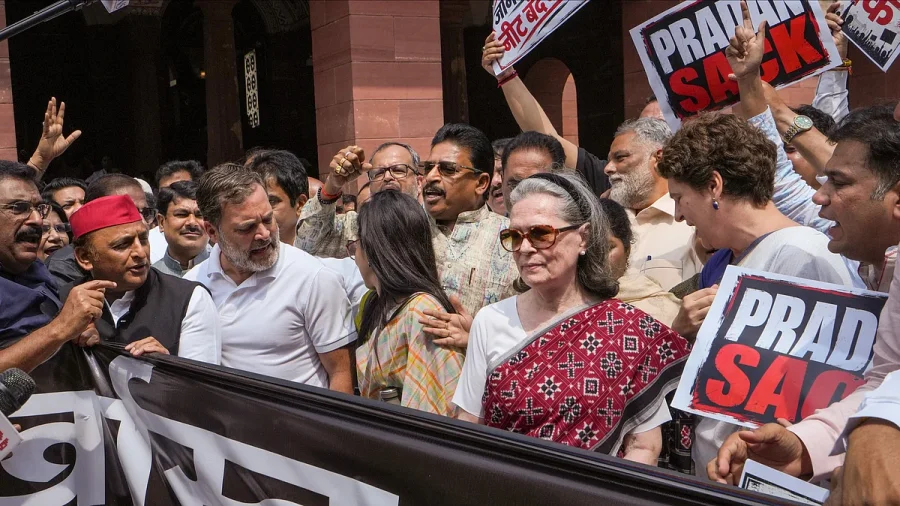
Congress Parliamentary Party chairperson Sonia Gandhi has launched a blistering attack on the Narendra Modi-led government, accusing it of responding to student demands for accountability with repression instead of dialogue. In a strongly worded opinion article published in The Hindu, Gandhi argued that the government has treated young Indians seeking educational reforms as “enemies of the nation” rather than the architects of the country’s future.
What Sonia Gandhi wrote: ‘An education system’s collapse, young India’s trauma’
In her op-ed, Gandhi described the wave of student protests sweeping across the country as not an isolated outburst but the inevitable consequence of years of policy failures, institutional neglect, and what she called the Modi government’s “arrogance” and refusal to accept accountability. “Their demands have been met with repression, not dialogue,” she wrote, directly challenging the government’s handling of student unrest.
Why this attack matters for Indian politics
The statement from Gandhi, a veteran opposition leader, signals a sharp escalation in political rhetoric around student issues. It comes at a time when student protests have gained momentum in several states, with demands ranging from fee reductions to curriculum reforms and better campus infrastructure. By framing the government’s response as repressive, Gandhi is attempting to position the Congress as the defender of young India’s aspirations.
Timeline of student unrest under the Modi government
Student protests have been a recurring feature in recent years, from the 2019–2020 demonstrations against the Citizenship Amendment Act (CAA) at Jawaharlal Nehru University (JNU) to more recent agitations over hostel fee hikes and exam delays. Gandhi’s op-ed appears to reference this broader pattern, arguing that the government has consistently chosen confrontation over consultation with student bodies.
Who is affected: Students and their families across India
Millions of students enrolled in central and state universities, as well as private institutions, are directly impacted by policy decisions on fees, scholarships, exam schedules, and curriculum changes. Many come from economically weaker backgrounds and rely on government support for higher education. The ongoing protests reflect deep anxiety about access, affordability, and quality of education in India.
Government’s stance on student protests so far
Union Education Minister Dharmendra Pradhan and other BJP leaders have previously dismissed student protests as politically motivated or instigated by opposition parties. The government has defended its education policies, including the National Education Policy (NEP) 2020, as transformative. However, critics argue that implementation has been slow and uneven, leaving many students frustrated.
What lies behind the rhetoric: Policy failures or political blame game?
Gandhi’s op-ed goes beyond immediate protests to question the broader direction of education policy under the Modi government. She points to underfunding of central universities, delays in teacher recruitment, and a perceived erosion of academic freedom. While the government counters with claims of increased budget allocation and digital initiatives, the gap between official claims and ground realities remains a contentious issue.
Confirmed facts vs what remains unclear
Confirmed: Sonia Gandhi published the op-ed in The Hindu on Friday. She accused the government of repression against student protesters. The op-ed title is “An education system’s collapse, young India’s trauma.” Unclear: Whether the government will issue a formal response. The specific student protests referenced are not named in the available story. The exact policy failures cited by Gandhi are not detailed in the source material.
Risks and balanced view
While Gandhi’s attack resonates with many students and opposition supporters, critics may argue that the Congress party’s own record on education during its years in power was far from perfect. The BJP is likely to counter by highlighting its initiatives like NEP 2020, increased IIT and IIM seats, and scholarship programs. The risk for the opposition is that such rhetoric may be seen as partisan rather than constructive, especially if not backed by concrete policy alternatives.
Wider trend: Student activism as a political flashpoint
Student protests have historically been a powerful force in Indian politics, from the anti-emergency movement to the 2019 CAA protests. The current wave reflects a generational shift, with young Indians more vocal about governance failures and more willing to challenge authority. Gandhi’s op-ed taps into this sentiment, but also risks polarizing the debate along party lines.
What students and parents should know
For students and parents watching this political battle, the key takeaway is that education policy remains a contested arena. Those affected by fee hikes, exam delays, or scholarship issues should engage with university authorities and student unions while also following parliamentary debates. The outcome of this political confrontation could influence future budget allocations and policy directions.
Future outlook: Will the government change its approach?
Given the BJP’s strong majority and its history of dismissing opposition criticism, a major policy shift is unlikely in the short term. However, sustained student protests and public pressure could force the government to announce specific relief measures or review contentious policies. The opposition will continue to use the issue to build momentum ahead of state and general elections.
Our Take
Sonia Gandhi’s op-ed is a significant political intervention, but its impact will depend on whether it translates into sustained parliamentary pressure and public mobilization. The real story here is not just the rhetoric but the underlying crisis in Indian higher education — underfunding, lack of accountability, and a growing disconnect between policy and student needs. Both the government and the opposition would do well to focus on solutions rather than slogans.
Frequently Asked Questions
What did Sonia Gandhi say about the Modi government and students?
In an op-ed in The Hindu, Sonia Gandhi accused the Modi government of treating student protesters as “enemies of the nation” and responding to their demands with repression instead of dialogue. She blamed years of policy failures and institutional neglect for the unrest.
Why did Sonia Gandhi write this op-ed now?
The op-ed comes amid a wave of student protests across India over issues like fee hikes, exam delays, and education policy failures. Gandhi appears to be using the moment to criticize the government’s handling of student affairs and position the Congress as a defender of young Indians.
Has the Modi government responded to Sonia Gandhi’s allegations?
As of the latest available information, there has been no formal response from the Modi government or BJP leaders to Gandhi’s op-ed. The government has previously dismissed student protests as politically motivated.
What are the main student demands behind the current protests?
Student demands vary by institution but commonly include fee reductions, timely exams, better hostel facilities, increased scholarships, and accountability in university administration. Some protests also target the implementation of the National Education Policy 2020.