
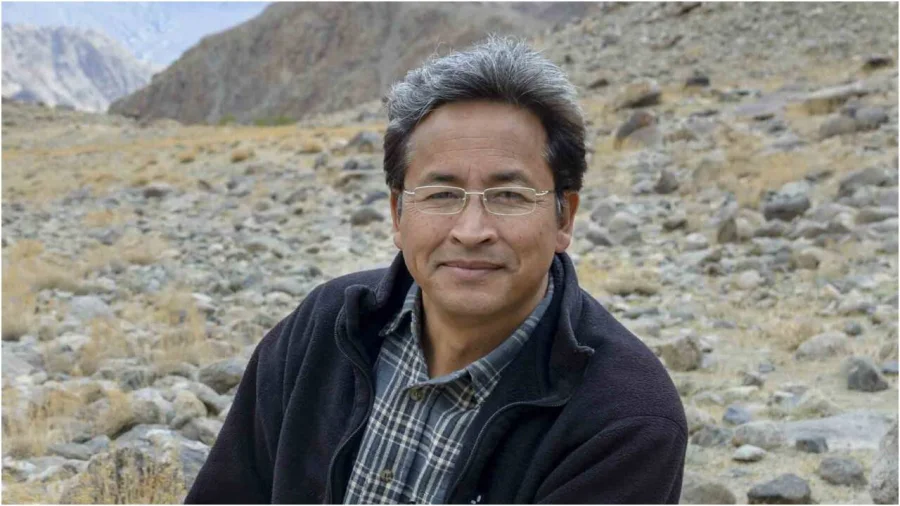
Sonam Wangchuk, the engineer-educator whose life inspired the character of Rancho in the film 3 Idiots, has returned home to Ladakh after a 26-day hunger strike that shook the education establishment. But it wasn’t his protest that drew attention this time — it was what he came back to. A sustainable ‘tribal house’ built from mud, warmed by passive solar design, and equipped with waterless sanitation.
A home built from the ground — literally
The house, located in a remote village in Ladakh, is a demonstration of what Wangchuk calls “living with the land.” Walls are made from locally sourced mud and stone, providing natural insulation against the region’s harsh cold. The roof slopes to capture winter sunlight, which is stored in thermal mass — a passive solar heating system that reduces reliance on imported kerosene or electric heaters. There is no conventional flush toilet; instead, a waterless sanitation system treats waste without using scarce water.
Why the house matters after a hunger strike
Wangchuk was discharged from Medanta Hospital in Gurugram after ending his fast on November 26, 2024. The protest, backed by the Climate Justice Platform (CJP), demanded reforms in the Indian examination system — specifically the scrapping of the high-stakes board exams and a shift to continuous assessment. The agitation led to the resignation of Union minister Dharmendra Pradhan, who oversaw education. Yet, even while negotiating with officials, Wangchuk never stopped talking about sustainable living. The Ladakh house is his living manifesto: that development need not destroy the environment.
How the design works in Ladakh’s extreme climate
Ladakh receives over 300 sunny days a year but temperatures drop below minus 30°C in winter. Passive solar design — using large south-facing windows and thick mud walls — can maintain indoor temperatures around 15–20°C without active heating. Waterless sanitation is crucial because Ladakh is a cold desert with limited freshwater. The house also uses locally sourced materials, reducing carbon footprint from transportation. Wangchuk has long advocated for such architecture through his organisation, the Students’ Educational and Cultural Movement of Ladakh (SECMOL).
The man behind the ‘3 Idiots’ fame
Wangchuk’s life and work were the template for the character Rancho in the 2009 blockbuster 3 Idiots. Yet he has always downplayed the connection. “The film is fiction; my work is real,” he has said. The Ladakh tribal house is a tangible continuation of that real work — a prototype for affordable, climate-resilient housing that could be replicated in other cold deserts and mountain regions.
What next for Wangchuk and his eco-home
After his discharge, Wangchuk plans to continue his education reform campaign, but also to expand the tribal house concept as a model for sustainable rural housing. He has invited architects, students, and policymakers to visit and learn from the design. The home currently serves as his personal residence and a demonstration site.
Our take
Sonam Wangchuk’s tribal house is more than an eco-friendly novelty. In a region facing the twin pressures of climate change and rapid modernisation, it offers a replicable blueprint. The fact that he has just come off a 26-day fast makes the statement even more powerful — he is not just advocating for change; he is living it.
Frequently Asked Questions
What materials are used in Sonam Wangchuk’s Ladakh house?
It uses local mud, stone, and passive solar design. The roofs and windows are oriented to capture winter sunlight, and thermal mass stores heat.
How does the waterless sanitation system work?
The system uses a composting or evaporative process that does not require water, critical in Ladakh’s arid climate. Detailed technical specs were not shared.
Why did Sonam Wangchuk go on a hunger strike?
He demanded an overhaul of the Indian examination system, specifically ending high-stakes board exams in favour of continuous assessment. The protest led to the resignation of education minister Dharmendra Pradhan.
Is the tribal house open for public visits?
Wangchuk has invited architects and students to learn from the design, but the house is a private residence. Interested parties can contact SECMOL for guidance.



