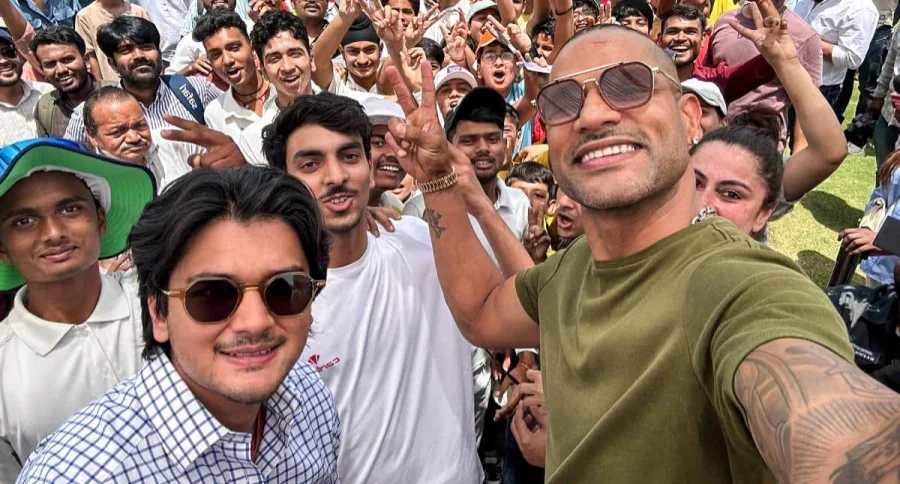
The political rift over youth protests in New Delhi took a new turn as the Cockroach Janata Party (CJP) directly responded to former Indian cricketer Shikhar Dhawan's public message urging trust in state institutions. The party's pointed question — 'Kafila Luta Kyu' — has ignited a fresh debate on social media.
Shikhar Dhawan's Appeal to Youth
Shikhar Dhawan, known for his calm demeanour on the cricket field, took to X (formerly Twitter) to address the ongoing youth protests. He wrote: "Our youth are the future of our nation. It is essential to understand their dreams, but at the same time, it is equally important to maintain patience in difficult times and keep faith in the country's institutions and government."
The former opener added that "the solution to every challenge emerges with patience" and expressed confidence that India will continue to move forward. His post was widely shared, with many praising his balanced stance while others questioned his timing.
CJP's Sharp Retort: 'Kafila Luta Kyu'
The Cockroach Janata Party (CJP) did not hold back. In a direct response to Dhawan's post, the party asked: "Kafila Luta Kyu?" — a Hindi phrase that translates to "Why loot the caravan?" The question appears to challenge Dhawan's call for patience, implying that the government is looting the aspirations of the youth.
The CJP's response has struck a chord with many protesters and opposition supporters who feel that calls for patience ignore the urgency of their demands. The phrase has since trended on social media, with users debating its meaning and intent.
Why This Exchange Matters
The clash between a celebrated sportsperson and a political party reflects the deepening divide over the youth protests. Dhawan, who has largely stayed away from political commentary, chose to speak up at a critical moment. His appeal for institutional trust stands in contrast to the CJP's confrontational stance.
For ordinary citizens, the exchange raises a fundamental question: Can calls for patience coexist with demands for immediate action? The answer may shape public opinion in the coming days.
Who Is Affected by This Political Rift
The youth protesters in New Delhi are at the heart of this standoff. Many feel that their concerns — ranging from unemployment to education reforms — are being ignored. Dhawan's message, while well-intentioned, has been seen by some as out of touch with the ground reality.
On the other hand, supporters of the government argue that patience and faith in institutions are essential for democratic functioning. The CJP's sharp response has only deepened the polarization, leaving little room for middle ground.
Official and Political Reactions
As of now, no official government statement has been issued in response to the exchange. However, political commentators have weighed in, with some calling Dhawan's post a "responsible gesture" and others labelling it "tone-deaf."
The CJP's response has been praised by opposition leaders who see it as a necessary counter to what they describe as "establishment propaganda." The party has not clarified whether it plans to escalate the matter further.
What 'Kafila Luta Kyu' Really Means
The phrase 'Kafila Luta Kyu' is rooted in Urdu and Hindi poetry, often used to question the plundering of a caravan — a metaphor for a community or group moving together. In this context, the CJP is accusing the government of looting the collective aspirations of the youth.
Linguists and political analysts note that the choice of words is deliberate — it evokes imagery of betrayal and exploitation, rather than mere disagreement. This rhetorical strategy is designed to resonate emotionally with those who feel disenfranchised.
Confirmed Facts vs What Remains Unclear
Confirmed: Shikhar Dhawan posted a message on X urging youth to trust institutions. The CJP responded with 'Kafila Luta Kyu'. Both posts are publicly visible and have been widely shared.
Unclear: Whether the CJP's response was coordinated or spontaneous. The exact number of protesters and the specific demands of the youth movement remain subject to varying reports. No official government response has been issued as of this writing.
Risks and Balanced View
Critics of the CJP's response argue that inflammatory language could escalate tensions rather than resolve them. They point out that Dhawan's call for patience, while perhaps unpopular, is not unreasonable in a democratic framework.
Supporters of the CJP counter that silence in the face of perceived injustice is complicity. They believe that strong language is necessary to hold power accountable. The risk, however, is that such exchanges further polarize an already divided public.
Wider Trend: Sportspersons and Political Commentary
Shikhar Dhawan is not the first sportsperson to wade into political waters. In recent years, several cricketers — from Kapil Dev to Virat Kohli — have made statements on national issues. However, the backlash against Dhawan's post highlights the growing expectation that public figures must take a clear stand.
This trend reflects a broader shift in Indian society, where neutrality is increasingly seen as a luxury. For sportspersons, the challenge is to balance personal beliefs with public responsibility.
Practical Guidance for Readers
For those following the protests, it is important to verify information from multiple sources before forming opinions. Social media posts, while influential, often lack context. Readers should look for official statements from government bodies and verified news reports.
If you are a student or young professional affected by the protests, consider engaging with local representatives or civil society groups. Peaceful dialogue and informed participation remain the most effective tools for change.
Future Outlook
The political standoff shows no signs of easing. The CJP's sharp response to Dhawan suggests that opposition parties are willing to confront even popular figures who support the government. Meanwhile, the youth protests continue, with no clear resolution in sight.
Analysts believe that the coming weeks will be crucial. If the government addresses some of the protesters' demands, the tension may subside. If not, the divide could widen, drawing more public figures into the fray.
Our Take
This exchange is more than a social media spat. It represents a fundamental disagreement about how democracy should function — whether through patient trust in institutions or through active, even confrontational, demand for change. Both sides have valid points, but the risk is that the middle ground disappears entirely.
For the average Indian, the lesson is clear: political engagement is no longer optional. Whether you agree with Dhawan or the CJP, staying informed and participating in the democratic process is the only way forward.
Frequently Asked Questions
What did Shikhar Dhawan say about the youth protests?
Shikhar Dhawan posted on X urging youth to remain calm, trust the country's institutions, and have patience during the ongoing protests. He emphasized that solutions emerge with patience.
What does 'Kafila Luta Kyu' mean?
'Kafila Luta Kyu' is a Hindi/Urdu phrase meaning "Why loot the caravan?" It is used metaphorically to question the plundering of a community's or group's collective aspirations.
Why did CJP respond to Shikhar Dhawan?
The Cockroach Janata Party (CJP) responded to Dhawan's post because they believe his call for patience ignores the urgency of the youth's demands. Their question implies the government is looting youth aspirations.
Is the government responding to this exchange?
As of now, no official government statement has been issued in response to the exchange between Shikhar Dhawan and the CJP.