
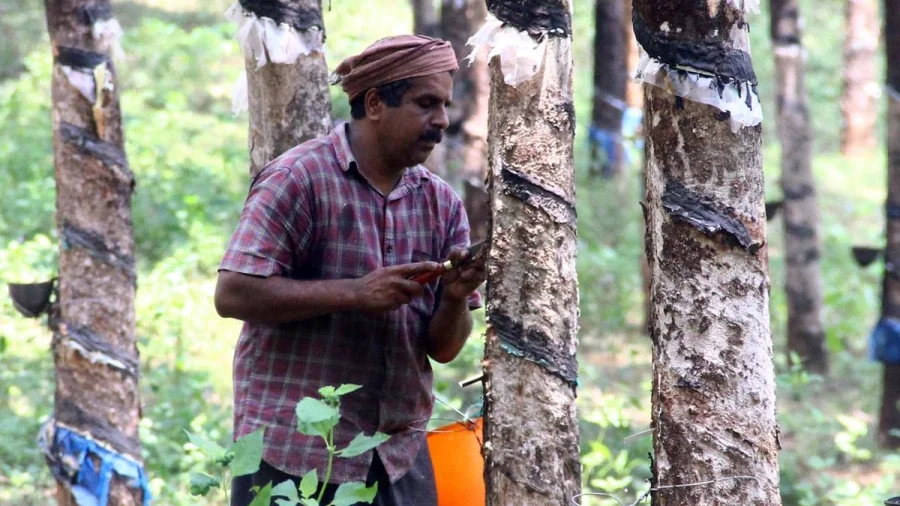
For decades, the early-morning ritual of tapping rubber trees has been the backbone of Kottayam’s rural economy. But that rhythm is breaking. A severe shortage of rubber tappers is now threatening the livelihoods of thousands of families who depend on rubber cultivation. The district panchayat has stepped in with a proposal that could change the game: a rural employment scheme designed specifically to train and employ tappers, offering up to 125 days of work a year at a daily wage of ₹401.
Why rubber tappers are disappearing from Kerala’s plantations
The shortage of rubber tappers is not new, but it has reached a critical point. Younger generations are moving away from the physically demanding work, seeking jobs in cities or overseas. Many traditional tappers have aged out of the profession. The result? Rubber farmers in Kottayam, one of Kerala’s key rubber-producing districts, are struggling to find skilled hands to tap their trees, leading to lost production and income.
The panchayat’s proposal: A MGNREGS-style model for rubber tapping
The district panchayat president said the proposal is modelled on the Mahatma Gandhi National Rural Employment Guarantee Scheme (MGNREGS), but tailored to the specific needs of rubber cultivation. Under the plan, trained tappers—including women—would be guaranteed up to 125 days of work annually at a daily wage of ₹401. The scheme would also provide training to ensure tappers have the necessary skills to extract latex efficiently without damaging the trees.
How the scheme could transform rural livelihoods
For families dependent on rubber cultivation, this scheme could be a lifeline. Many small and marginal farmers rely on rubber as their primary source of income. A guaranteed wage for tappers would not only address the labour shortage but also provide stable, dignified employment for rural workers. The inclusion of women is particularly significant, as rubber tapping has traditionally been male-dominated. Training women as tappers could open new economic opportunities and challenge gender norms in the sector.
Official response: What the district panchayat has said so far
The district panchayat president said the proposal could enhance livelihoods for many families dependent on rubber cultivation. The panchayat is now working on the details, including funding sources, training modules, and the mechanism for linking tappers with farmers. The president emphasized that the scheme is still in the proposal stage and will require approval from higher authorities and coordination with the state government.
What this means for Kerala’s rubber economy
Kerala accounts for over 70% of India’s natural rubber production, and Kottayam is a major contributor. The shortage of tappers has been a persistent headache for the Rubber Board and farmers alike. If the panchayat’s scheme succeeds, it could serve as a pilot model for other rubber-growing districts in the state. It could also help stabilize rubber prices by ensuring consistent supply, benefiting both farmers and the broader economy.
Confirmed facts vs what remains unclear
Confirmed: The district panchayat has proposed a rural employment scheme for rubber tappers. The scheme offers up to 125 days of work at ₹401 per day. Training will be provided, and women are included. Unclear: The exact funding mechanism, implementation timeline, eligibility criteria, and whether the scheme will be funded by the state or central government. It is also unclear how many tappers the scheme aims to train and employ in the first phase.
Risks and balanced view
While the proposal is promising, challenges remain. The daily wage of ₹401 may not be attractive enough to draw workers away from other employment opportunities, especially in a state where the minimum wage for certain sectors is higher. There is also the question of sustainability: will the scheme be a one-time intervention or a long-term solution? Critics may argue that without addressing the deeper issues—such as the declining profitability of rubber farming and the lack of social security for tappers—the scheme may only offer temporary relief.
Wider trend: The labour crisis in India’s plantation sector
The rubber tapper shortage is part of a larger labour crisis affecting India’s plantation sector. From tea gardens in Assam to coffee estates in Karnataka, plantation owners are struggling to find workers. The reasons are similar: low wages, hard physical labour, and migration to urban areas. Kottayam’s scheme could offer a blueprint for other regions facing similar challenges, by combining skill training with guaranteed employment.
Practical guidance for rubber farmers and aspiring tappers
For rubber farmers in Kottayam, the scheme could be a way to secure a reliable workforce. Farmers should stay in touch with the district panchayat for updates on registration and implementation. For rural workers, especially women, interested in becoming tappers, this is an opportunity to gain a skill and earn a steady income. Training programs are expected to be announced soon. Those interested should contact their local panchayat office for more information.
Future outlook: What happens next
The district panchayat is expected to hold consultations with stakeholders, including rubber farmers, tappers, and the Rubber Board, to finalize the scheme. If approved, the first batch of training could begin within the next few months. The success of the scheme will depend on effective implementation, adequate funding, and the willingness of workers to take up tapping as a profession. If it works, Kottayam could set a precedent for the entire rubber industry.
Our take
This proposal is a timely and practical response to a crisis that has been brewing for years. The shortage of rubber tappers is not just a labour issue—it is a threat to the livelihoods of thousands of families and the stability of Kerala’s rubber economy. By offering guaranteed work and training, the district panchayat is addressing both the immediate need for tappers and the longer-term goal of making rubber tapping a viable, dignified profession. The inclusion of women is a progressive step that could expand the labour pool and challenge traditional gender roles. However, the devil will be in the details: the wage rate, funding, and implementation will determine whether this scheme becomes a model or just another proposal. For now, it offers a glimmer of hope for a sector in need of reinvention.
Frequently Asked Questions
What is the Kottayam rural employment scheme for rubber tappers?
It is a proposed scheme by the Kottayam district panchayat to address the shortage of rubber tappers. It offers training and up to 125 days of guaranteed work annually at a daily wage of ₹401, with a focus on including women.
Why is there a shortage of rubber tappers in Kottayam?
The shortage is due to younger generations moving to cities or overseas for work, the physically demanding nature of tapping, and an aging workforce. Many traditional tappers have retired without replacements.
How much will rubber tappers earn under this scheme?
Tappers will earn a daily wage of ₹401 for up to 125 days of work per year. This is modelled on the MGNREGS wage structure but tailored for rubber tapping.
Can women apply to become rubber tappers under this scheme?
Yes, the scheme explicitly includes women. Training will be provided to equip them with the skills needed for rubber tapping, which has traditionally been a male-dominated profession.



