
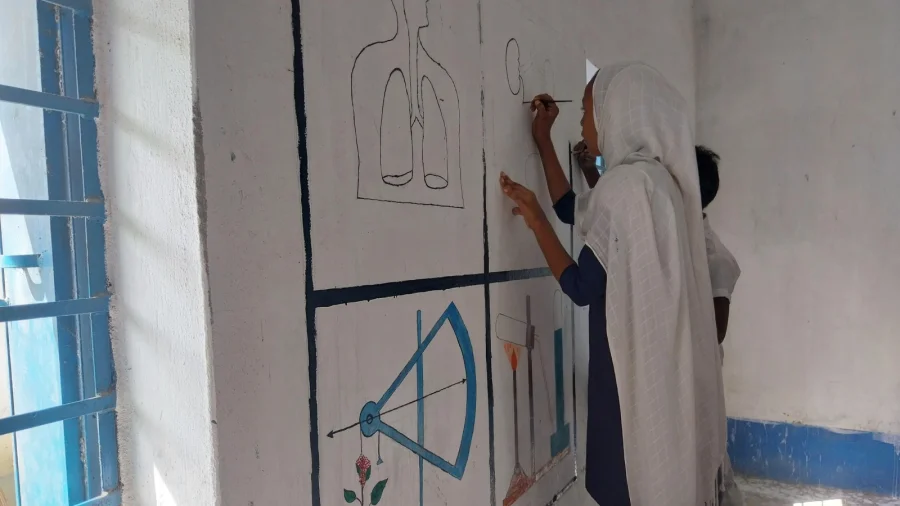
A child walking past a school wall in Malda may soon pause to trace a letter or follow the orbit of a painted planet. Around 3,000 government schools across the West Bengal district are being transformed with "learning walls" — turning plain surfaces into everyday lessons that begin with the alphabet and stretch all the way to the solar system. The reported initiative reframes the school building itself as a silent teacher. Here is why that idea matters, and what still needs to be confirmed.
What a 'learning wall' actually looks like
A learning wall is exactly what the name suggests: a wall painted or illustrated with educational content designed for repeated, informal viewing. In the Malda initiative, as described in the headline report, the artwork spans foundational literacy — alphabets and early language cues — to elementary science concepts like the solar system.
The placement is deliberate. These are not museum murals; they sit in corridors, entrances, and classroom-adjacent spaces where children pass daily. The idea is that a child absorbs a letter or a planet's name even between classes, without opening a textbook.
How 3,000 schools fit into one district-wide push
The number gives the effort its significance. Transforming roughly 3,000 government schools means the drive is not a pilot or a single-campus beautification project. It is a district-level intervention touching the core of Malda's public education infrastructure.
For students in government schools, where supplementary learning aids can be scarce, the walls become a free, always-available visual reference. For teachers, they offer a shared starting point for classroom conversations.
Why painted planets and alphabets can support real learning
Young children, especially those in early primary grades, learn heavily through visual recognition. Frequent, low-pressure exposure to symbols — a letter they see every day on a wall — strengthens recall in ways that occasional classroom charts cannot always match.
The solar-system element adds curiosity value. A child who asks "which planet is that?" has already begun a science lesson on their own terms. That mix of early literacy and elementary science coverage makes the wall artwork an unusual hybrid: infrastructure, teaching aid, and curiosity trigger at once.
What official confirmation is still pending
The available report identifies the transformation and its scale, but does not yet specify which department or agency is executing the drive, the funding source, or the completion timeline. District administrations typically anchor such programmes through education or panchayat departments, but that detail remains to be confirmed here.
Until an official statement or documentary record is published, the precise rollout model — including whether all 3,000 schools are complete, underway, or scheduled — should be treated as an open question.
The deeper point: infrastructure as a teaching tool
India has spent heavily on school infrastructure over the past decade, yet the link between buildings and learning outcomes often stays weak. The Malda learning-wall model tries to close that gap by embedding pedagogy into the built environment itself.
It is a low-tech idea in a high-tech age — no screens, no devices, no connectivity required. That simplicity is also its strength in schools where digital tools remain unevenly available.
What is confirmed versus what remains unclear
Verified from the available report: the district is Malda, the setting is government schools, the reported count is around 3,000, and the content spans alphabets to the solar system. Still unverified: the name of the implementing body, the budget, the start date, and any measured impact on learning levels.
Nothing in this brief should be read as an official operational announcement until those details surface.
A balanced view: paint alone does not teach
Visual walls are an aid, not a substitute for classroom instruction. Education researchers would caution that murals work best when teachers actively reference them; a wall that is merely decorative adds colour, not learning.
There are also practical risks. Outdoor paint fades in sun and monsoon, and maintenance across 3,000 campuses is a real logistical test. The drive's long-term value will depend on upkeep, teacher engagement, and whether content stays aligned with the curriculum.
Part of a wider turn toward foundational learning
The initiative arrives amid a broader national push on foundational literacy and numeracy — the basic reading and arithmetic skills that children must master in early primary years. Malda's wall art, with its emphasis on alphabets first and science concepts later, fits that educational priority.
Similar wall-based interventions have appeared in other states, making this less a one-off experiment and more a visible example of a growing pattern: using school spaces themselves to reinforce basics.
What parents and teachers should watch for
For parents in Malda, the practical question is simple — do the walls actually get used in lessons, or do they become decoration? Asking children what they noticed on the wall is an easy way to test whether the art is registering.
Teachers facing these walls can integrate them into routine: a five-minute "wall walk" before class, pointing at letters or planets, costs nothing and can reinforce the intended benefit.
What could come next
If the transformation is completed as reported, the next phase would logically be evaluation — measuring whether schools with learning walls show improvement in early literacy or science awareness compared with those without.
Depending on results and maintenance costs, the model could expand beyond Malda or be replicated by other districts. For now, the immediate milestone is the completion and upkeep of the 3,000-school visual overhaul.
Our Take
The Malda learning-wall drive is a reminder that educational innovation does not always require expensive technology — sometimes it requires looking at an ordinary school wall and asking what it could teach. The scale, at 3,000 government schools, is genuinely ambitious. The risk is that without teacher integration and maintenance, the art ages into background noise.
The real test will come in the next academic cycle: whether children in these schools recognise more letters and ask better questions about the sky above them.
Frequently Asked Questions
What are learning walls in Malda schools?
Learning walls are school walls painted with educational content such as alphabets, numbers, and science illustrations. In Malda, the reported drive is transforming around 3,000 government schools with artwork that runs from basic alphabet lessons to solar system imagery.
How many government schools in Malda are being transformed?
According to the headline report, approximately 3,000 government schools across Malda district are being covered under the learning walls transformation.
What topics do the Malda school wall artworks cover?
The reported artwork spans two broad areas: foundational literacy content beginning with alphabets, and elementary science visuals extending to the solar system. This mix aims to support both early reading skills and scientific curiosity.
Do wall paintings actually improve student learning?
Wall art can reinforce visual memory through repeated daily exposure, especially for young children, but it works best when teachers actively use the walls in lessons. No outcome data from the Malda drive has been published yet, so its measurable impact on learning levels is still to be established.
[NEWS_SCHEMA] {"@context":"https://schema.org","@type":"NewsArticle","headline":"When school walls begin to teach: the Malda art drive reshaping 3,000 government schools","description":"Walls in Malda's government schools now teach too — from alphabets to solar system. Inside the 3,000-school learning wall transformation.","image":"","datePublished":"2025-06-15T08:30:00+05:30","dateModified":"2025-06-15T08:30:00+05:30","author":{"@type":"Person","name":"Education Desk","url":"","sameAs":[]},"publisher":{"@type":"Organization","name":"Digital Newsroom","logo":{"@type":"ImageObject","url":""}},"mainEntityOfPage":{"@type":"WebPage","@id":""},"articleSection":"Education","keywords":"Malda learning walls, government schools, school wall art, foundational literacy, West Bengal education"} [SOURCES] No high-confidence external source was available for verification at the time of writing. This brief is based solely on the reported headline — "Alphabet to solar system art: How Malda is transforming 3,000 government schools with 'learning walls'" — and official confirmation from the Malda district administration is awaited.