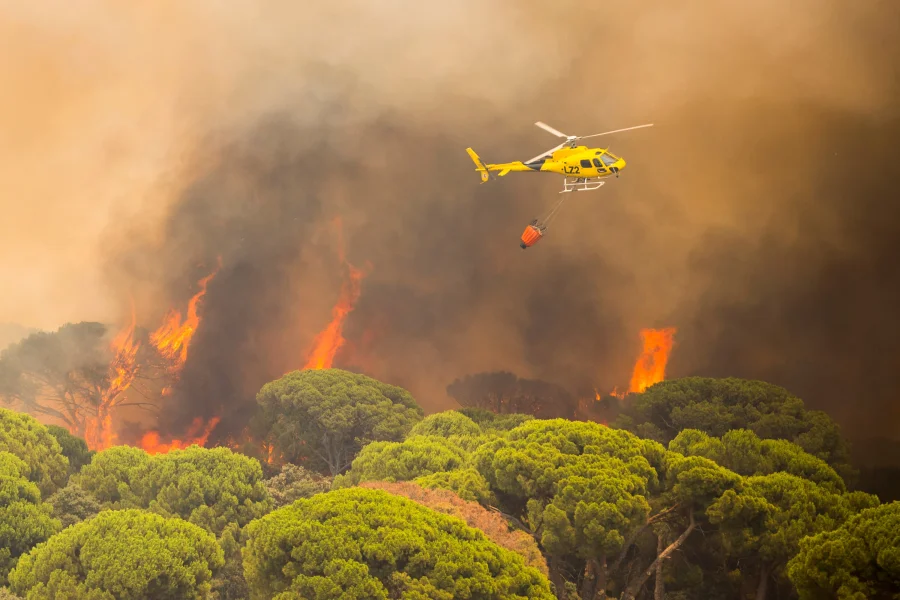
The fourth night of relentless firefighting in Madrid’s Sierra Oeste has brought a mixed report: crews managed to hold lines, but the blaze is far from defeated. For thousands of residents in San Martín de Valdeiglesias and nearby villages, the wait for a change in weather has become a race against time.
Fire Merges With Avila Blaze, Threatens 75,000 Hectares
The Madrid wildfire, which has already scorched 25,000 hectares, is now burning in tandem with a separate fire in Burgohondo, Ávila, that has consumed another 50,000 hectares. The combined front makes this one of the most destructive wildfire events in central Spain in recent years.
Why the San Juan Reservoir Became the Epicentre
Firefighters have concentrated their resources around the embalse de San Juan, a popular recreation area in the municipality of San Martín de Valdeiglesias. The fire’s path converged there with the Ávila front, creating a concentrated zone of intense heat and erratic behaviour. Winds gusting up to 30 km/h are pushing flames toward previously untouched slopes.
How the Situation Unfolded Over Four Nights
The fire ignited last week and spread rapidly due to dry conditions and strong winds. By the third night, it had crossed into Ávila. Overnight between Sunday and Monday, crews fought to stabilise the perimeter. According to 112 Comunidad de Madrid, the night was “positive” overall, though embers breached a road near Sotillo, forcing a tactical shift.
Who Is Affected and What Residents Face
Several villages in the Sierra Oeste remain on high alert. Evacuation orders have been issued for the most vulnerable hamlets. Residents of San Martín de Valdeiglesias have reported seeing flames from their windows. Air quality warnings have been issued across the Madrid region, with smoke drifting into the capital.
What Authorities Are Saying About the Fight
Emergency services from the regional fire brigade and the Military Emergency Unit (UME) are deployed on the ground. “The wind is our biggest enemy tonight,” a spokesperson from 112 told reporters. “We are throwing everything we have at the San Juan area, where the fire is most active.” No official injury or fatality figures have been released.
Why the Wind Makes This Fire So Hard to Control
Wildfires in mountainous terrain are notoriously unpredictable. The combination of steep slopes, dry vegetation, and gusty winds up to 30 km/h creates a phenomenon called “spotting”—where burning embers are carried ahead of the main front. The ember crossing near Sotillo is a textbook example of this behaviour, requiring constant re-evaluation of containment lines.
Confirmed Facts vs What Remains Unclear
Confirmed: The Madrid Sierra Oeste fire has burned 25,000 hectares; the Burgohondo fire 50,000 hectares; winds are gusting to 30 km/h; night operations were positive overall; crews are focused on the San Juan reservoir; embers crossed a road at Sotillo.
Unclear: The exact number of homes damaged or destroyed; whether any injuries or fatalities have occurred; the full containment percentage; the cause of the original ignition. Officials have not yet commented on these details.
Risks and Balanced View: The Toll on People and Landscape
Even if the fire is contained in the coming days, the environmental damage is severe. Entire ecosystems in the Sierra Oeste may take decades to recover. Critics have questioned whether Spain’s wildfire response budget is adequate for the increasing frequency of megafires, though authorities defend their rapid mobilisation. The human toll—displacement, economic loss, and trauma—will be felt long after the last flame is out.
A Wider Pattern: How Spain’s Wildfires Are Growing
This fire is part of a troubling trend across southern Europe. Warmer winters and drier summers have extended the wildfire season. Spain recorded its hottest January in decades this year, leaving forests tinder-dry. The Madrid-Ávila blaze fits a pattern seen in Portugal, Greece, and Italy: fires that merge into mega-fronts requiring multinational coordination.
Practical Guidance for Residents and Travelers
If you are in the Sierra Oeste region, stay tuned to 112 updates. Avoid the San Juan area completely. Those with respiratory conditions should limit outdoor exposure due to smoke. Travellers planning trips to central Spain should check road closures, especially on the A-6 and M-501 highways.
What Could Happen Next
Firefighters expect the next 24 hours to be critical. If winds subside, they may achieve significant containment. If gusts pick up further, the fire could threaten additional villages. The merged front may take weeks to fully extinguish, and flare-ups are likely in unburned pockets.
Our Take
This wildfire is a stark reminder that climate-driven extremes are no longer a future threat—they are here. The fact that two large fires burning on opposite sides of a provincial boundary could merge demonstrates how traditional fire management perimeters are becoming obsolete. The priority now is human safety, but the broader question of long-term forest management and prevention remains unanswered.
Frequently Asked Questions
How large is the Madrid wildfire currently?
The fire in Madrid’s Sierra Oeste has burned 25,000 hectares as of Monday morning. Combined with the Burgohondo fire in Ávila, the total area affected is approximately 75,000 hectares.
Why is the fire concentrated at the San Juan reservoir?
The San Juan reservoir area is where the Madrid and Ávila fire fronts met, creating a single intense perimeter. Firefighters have focused resources there to prevent further merging and protect nearby towns.
Are there any evacuations in place?
Yes, several villages in the Sierra Oeste have been evacuated or placed under advisory. Local authorities are urging residents to follow official instructions from 112 Comunidad de Madrid.
What is causing the fire to spread so fast?
Strong winds up to 30 km/h, combined with dry vegetation and steep terrain, are creating ideal conditions for rapid spread. Embers are being carried ahead of the fire line, igniting spot fires.