Summary
A landlocked country is a nation that does not have a direct connection to an ocean or a sea. These countries are entirely surrounded by the land of other nations. Being landlocked can make international trade and travel more difficult because these countries must rely on their neighbors to reach global shipping routes. This article looks at the ten largest landlocked countries in the world by total land area and explains the unique challenges they face.
Main Impact
The main impact of being a large landlocked country is the high cost of moving goods. Since these nations cannot operate their own sea ports, they must pay fees to use the ports of nearby countries. This often makes imported goods more expensive for their citizens. It also makes it harder for these countries to sell their own products, like oil, minerals, or farm goods, to the rest of the world. Geography plays a massive role in their economic growth and political relationships with their neighbors.
Key Details
What Happened
While most of the world's nations have coastlines, 44 countries do not. Among these, a few stand out because of their massive size. These nations are spread across different continents, with the largest group located in Africa and Central Asia. Despite their size, many of these countries struggle with poverty or slow economic growth because of their location. However, some have found ways to use their large land area to produce valuable resources like gold, oil, and natural gas.
Important Numbers and Facts
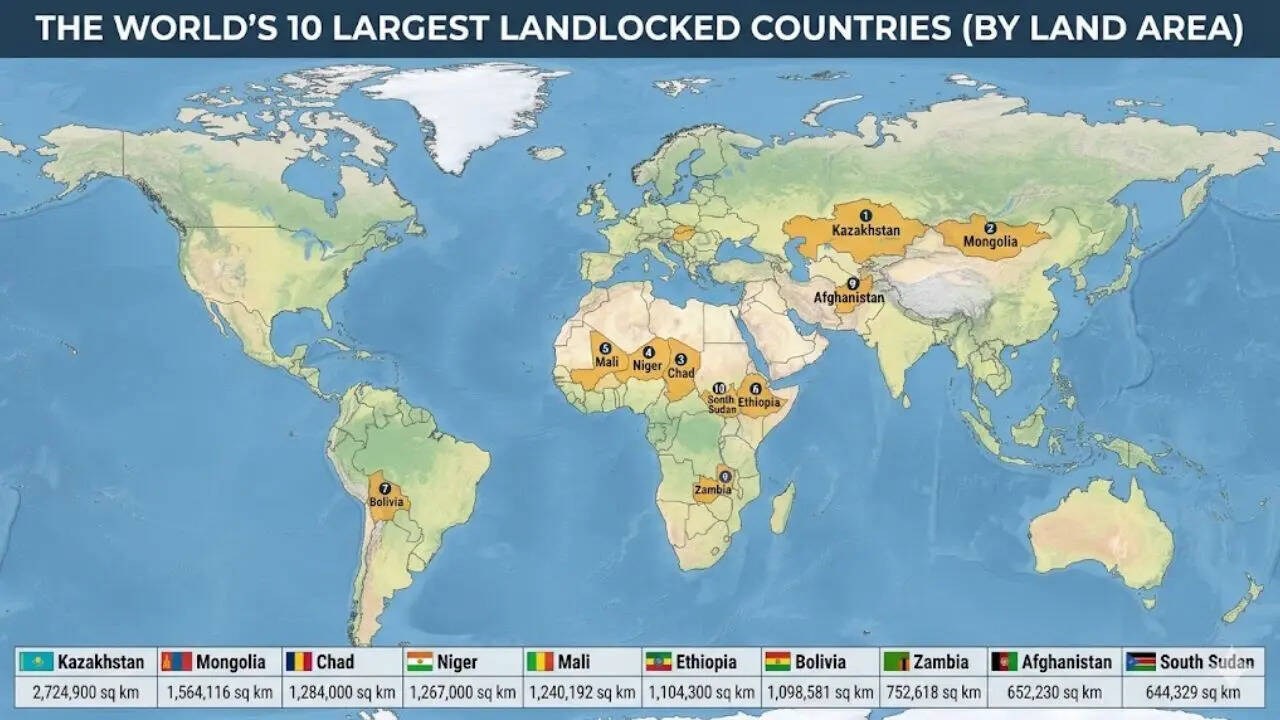
Here are the ten largest landlocked countries based on their total land area:
- 1. Kazakhstan: This is the largest landlocked country in the world, covering about 2.7 million square kilometers. It is located in Central Asia.
- 2. Mongolia: Located between Russia and China, it covers about 1.56 million square kilometers.
- 3. Chad: A large nation in North-Central Africa with an area of about 1.28 million square kilometers.
- 4. Niger: Located in West Africa, it covers roughly 1.27 million square kilometers.
- 5. Mali: Another West African nation, it has a land area of about 1.24 million square kilometers.
- 6. Ethiopia: The most populous landlocked country, covering 1.1 million square kilometers in East Africa.
- 7. Bolivia: The largest landlocked country in South America, with an area of 1.09 million square kilometers.
- 8. Afghanistan: A mountainous country in South-Central Asia covering 652,000 square kilometers.
- 9. Central African Republic: Located in the middle of Africa, it covers about 622,000 square kilometers.
- 10. South Sudan: The world's newest country, covering about 619,000 square kilometers in East-Central Africa.
Background and Context
The borders of these countries were often decided by historical events, wars, or colonial rules. For example, Ethiopia used to have a coastline, but it became landlocked after Eritrea gained independence in the 1990s. Bolivia also had a coast once, but it lost its access to the sea during a war with Chile in the late 1800s. In Central Asia, countries like Kazakhstan became landlocked after the Soviet Union broke apart. Understanding this history helps explain why some of these nations have difficult relationships with the neighbors that control their access to the sea.
Public or Industry Reaction
International groups like the United Nations have recognized that landlocked countries need extra help. They often refer to them as Landlocked Developing Countries (LLDCs). Economists point out that these nations spend a much higher percentage of their earnings on transport compared to countries with sea access. To help, international organizations work on "transit agreements." These are special deals that allow landlocked countries to move their goods through neighboring countries with fewer taxes or delays. Many global investors are also looking at how digital technology can help these countries trade services online, which does not require a sea port.
What This Means Going Forward
The future for these large nations depends on better infrastructure. Many are building long-distance railways and pipelines to move resources more quickly. For example, Kazakhstan has become a major link in trade between China and Europe by building modern rail lines. In Africa, countries like Ethiopia are investing heavily in new roads and dams to boost their power. If these countries can improve their transport links and maintain peaceful ties with their neighbors, their large size could become a major advantage for farming and energy production.
Final Take
Being a large landlocked country brings both big opportunities and big problems. While these nations have plenty of space and natural resources, their lack of sea access remains a major hurdle for trade. Success for these ten giants will depend on how well they can connect with the rest of the world through land, air, and digital networks. Geography is a challenge they must live with, but it does not have to stop their progress.
Frequently Asked Questions
Which is the largest landlocked country?
Kazakhstan is the largest landlocked country in the world. It is so big that it is the ninth-largest country overall, even though it has no ocean coast.
What is a "doubly landlocked" country?
A doubly landlocked country is a country that is surrounded only by other landlocked countries. This means a person would have to cross at least two borders to reach an ocean. There are only two in the world: Uzbekistan and Liechtenstein.
Why is being landlocked bad for a country's economy?
It is usually bad because shipping goods by sea is the cheapest way to trade globally. Landlocked countries must use trucks or trains, which cost more. They also have to follow the rules and pay the fees of the countries they pass through.