By [Reporter Name] | Geopolitics Desk
A wedding celebration turned to grief, and the Middle East edged closer to open confrontation, after Iran accused the United States of killing four people — including two children — in an airstrike it labelled a "war crime." Washington has rejected the claim that civilians were targeted. Tehran's answer, according to the original report, was swift: missiles and drones fired at US targets across the region.
This brief is based only on the supplied headline and original story. Independent details — including the exact location and date — were not available for verification at the time of writing.
What Tehran says happened at the wedding
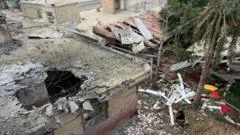
Iranian media reported that four people were killed at a wedding when shrapnel from a US strike hit a home. Two of the dead were children, the reports said. The account frames the incident as a deliberate attack on a civilian gathering — which is why Tehran has publicly described it as a "war crime."
Washington: 'We did not target civilians'
The United States has denied targeting civilians in connection with the incident. No detailed US statement addressing the specific wedding strike allegation was included in the original report, leaving the American position limited to that denial.
Iran's military response: missiles and drones at US targets
According to the original story, Iran followed the alleged strike by launching missiles and drones at US targets in the Middle East. The scale of the barrage, the locations hit, and any casualties or damage on the US side were not specified and remain unverified.
Why this matters: a cycle that is hard to stop
Even unconfirmed casualty claims carry weight in the Middle East's most dangerous flashpoints. Each side now has a narrative: Iran points to dead civilians at a wedding; the US points to its right to defend its forces. When leaders talk in terms of "war crimes" and answer with missile fire, the margin for miscalculation shrinks dramatically.
For civilians in the region, the consequences are not abstract. Weddings, homes, and neighbourhoods — the ordinary spaces of daily life — become the first places to feel the fallout of a confrontation between two militaries.
Confirmed versus still unclear
What is confirmed, at this stage, is limited to what each side says:
• Iran has alleged the strike and called it a war crime.
• Iranian media has reported four dead, including two children, from shrapnel hitting a home.
• The US has denied targeting civilians.
• Iran has responded with missiles and drones at US targets.
What remains unclear: whether a US strike actually occurred, whether the wedding deaths happened as described, and what damage Iran's retaliation caused. All of these need independent verification.
Risks and a balanced view
In high-stakes conflicts, casualty claims can become weapons themselves. Both governments have an interest in shaping how the world sees this moment — Iran in rallying regional support, the US in defending the legitimacy of its operations. That does not mean the reported deaths are untrue; it means they must be examined with care until independent evidence emerges.
Human rights organisations and international observers typically call for transparent investigations in such cases. Whether any third-party probe is permitted — by either side — will be an early test of whether accountability is genuine or merely rhetorical.
What to watch now
The immediate question is whether Washington responds militarily to Iran's missile and drone launches. A second is whether more civilian casualty reports surface — and whether they are verified. A third is how regional partners, particularly those hosting US forces, react to the escalating risk on their soil.
Our Take
This story is a reminder of how fast a localised incident can become a regional crisis — and how quickly truth becomes a casualty of war. The alleged deaths of children at a wedding demand genuine investigation, not just competing press releases. Until independent fact-finders gain access, the world is left with two incompatible versions of events and a region braced for what comes next. The only responsible position is to hold both claims open, demand evidence, and recognise that the real victims — the dead, the grieving, the displaced — are the ones with no voice in either narrative.
Frequently Asked Questions
Did the US confirm it carried out the strike?
No. The United States has denied targeting civilians, but no confirmed US statement addressing the specific wedding strike allegation has been verified. The incident itself remains unconfirmed by independent sources.
How did Iran respond to the alleged wedding strike?
According to the original report, Iran launched missiles and drones at US targets in the Middle East shortly after the alleged strike. The details and impact of that retaliation have not been independently verified.
Who were the reported victims of the wedding strike?
Iranian media said four people were killed at a wedding, including two children, when shrapnel hit a home. These casualty figures come from Iranian sources and have not been independently confirmed.
Is the wedding strike legally a 'war crime' as Iran claims?
A formal war-crime determination requires an independent investigation into whether civilians were deliberately targeted or the attack was disproportionate. Iran has made the allegation, but no neutral judicial or international body has ruled on it.