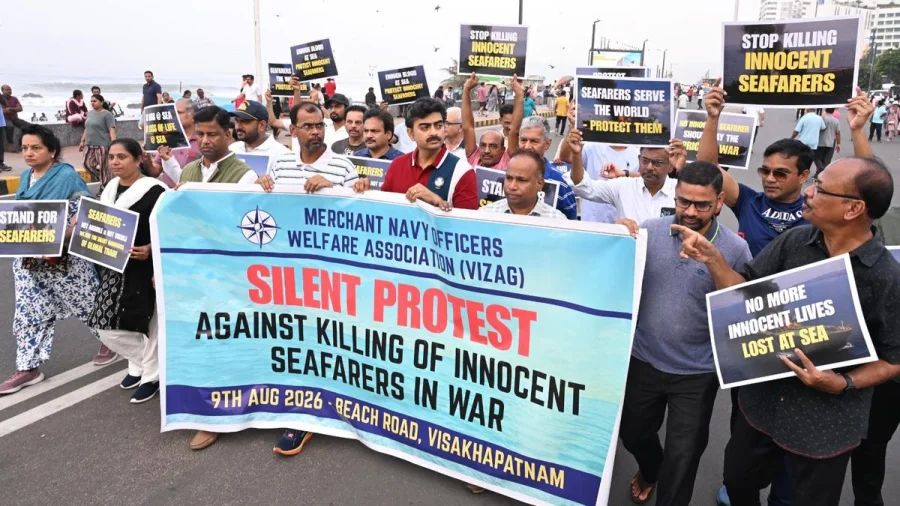
Indian Seafarers Silent Protest Over War Zone Deaths
Visakhapatnam's waterfront fell into a silence that was never meant to be quiet. Seafarers — the men and women who keep global trade moving — stood together wit...
Admin
The Tasalli
728 x 90Header Slot
TL;DR — Quick Summary
Seafarers in Visakhapatnam held a silent protest against the killing of maritime workers in war zones, reacting to what is described as a mounting toll among Indian crews since Iran-Israel-US hostilities erupted on February 28, 2026. The demonstration underscores how civilian sailors are increasingly exposed to danger in conflict-hit shipping corridors. With no official response documented yet, the protest has put the spotlight back on maritime safety protocols.
Key Facts
Main Update
Seafarers held a silent protest in Visakhapatnam against the killing of maritime workers in war zones, according to the original report.
Impact
The protest comes as Indian seafarers face what is described as a mounting toll since hostilities involving Iran, Israel and the United States began on February 28, 2026.
Form of Protest
The demonstration was deliberately silent — an expression of grief rather than a conventional slogan-driven rally.
Current Status
The exact number of participants and the identities of organising groups have not been independently confirmed.
Official Response
No statement from Visakhapatnam port authorities or the Indian government has been documented in the available report.
What Next
The protest is likely to renew demands for safer routing of commercial vessels and better protection for Indian crews transiting volatile waters.
Visakhapatnam's waterfront fell into a silence that was never meant to be quiet. Seafarers — the men and women who keep global trade moving — stood together without slogans, a protest framed not in anger but in grief. Their message, aimed at the world's warring powers, was simple: Indian crews are dying in waters far from home, and the world is barely noticing.
A port city's silent statement
The demonstration in Visakhapatnam, one of India's busiest maritime hubs on the east coast, was designed to be seen rather than heard. According to the original report, the protest comes against the backdrop of a mounting toll among Indian seafarers since the outbreak of hostilities involving Iran, Israel and the United States on February 28, 2026.
The choice of silence is significant. For families who have lost loved ones at sea, and for sailors who still transit those dangerous routes, the quiet carried more weight than any chant. It signalled that the deaths of Indian seafarers in war zones had become a pattern, not an accident.
Why February 28 changed the calculus for Indian crews
The escalation that began on February 28, 2026, transformed an already tense maritime region into a far more lethal one. Commercial vessels, once assumed to be outside the scope of direct attack, suddenly found themselves in the line of fire.
India has long been one of the world's largest suppliers of seafarers, with lakhs of Indians crewing bulk carriers, tankers and container ships on international routes. That role — vital to global supply chains — has also made Indian sailors unusually exposed when shipping lanes pass through active conflict zones.
The geopolitics behind the rising danger at sea
Hostilities involving Iran, Israel and the United States have turned strategic waterways into risk corridors. While the original report does not specify which maritime routes were affected, the geography of the conflict points to vital chokepoints in the region where a substantial share of global oil and goods traffic moves daily.
Historically, even during intense regional conflicts, merchant ships were largely spared. That understanding has eroded. The mounting toll among Indian seafarers described in the report suggests that civilian vessels are no longer automatically treated as off-limits in this confrontation.
Grief on the waterfront: the human cost of the toll
Behind every reported incident involving a commercial vessel, there are crew members with names, families and futures — many of them Indian. For seafaring communities in ports like Visakhapatnam, the risk is not abstract. Colleagues, neighbours and relatives crew the very ships that pass through these volatile waters.
The silent protest was, above all, an act of remembrance. It reflected an accumulation of loss that families have been carrying quietly, often without public attention or adequate official acknowledgment.
Official silence: no response documented yet
At the time of writing, no official statement from Visakhapatnam port authorities, the Andhra Pradesh government or the Union Ministry of Ports, Shipping and Waterways had been documented in the original report. That absence of response is itself a point of concern for the protesting seafarers.
It is not yet clear whether the demonstration was coordinated by a seafarers' union, a regional maritime association, or informal groups of affected families. These details remain unverified, and any claims about specific casualties should be treated cautiously until independently confirmed.
Merchant sailors in the crossfire: what the protest really means
The Visakhapatnam demonstration highlights a deeper structural problem: seafarers are civilians performing a commercial duty, yet they increasingly bear the consequences of military escalation. They do not choose sides in a conflict. They simply carry food, fuel and goods that nations depend on.
Analysts view the protest as a signal that Indian maritime workers are demanding more than sympathy. The likely underlying asks include safer route planning, better war-risk coverage, clear protocols for crew evacuation, and accountability when ships are struck.
Confirmed facts versus what remains unverified
What is confirmed from the original report is limited and should be stated plainly. A silent protest by seafarers did take place in Visakhapatnam. The demonstration was directed against killings of maritime workers in war zones. The reported context is a rising toll among Indian seafarers following the February 28, 2026 outbreak of hostilities involving Iran, Israel and the United States.
What remains unverified: the number of protesters, the organising bodies, the specific incidents or casualty figures behind the protest, and whether any official dialogue has followed. No independent data has been published in the available material. Readers should distinguish between the verified fact of the protest and the broader claims surrounding it.
Safety concerns and the debate shipping firms cannot ignore
The protest also reopens a long-running debate about responsibility. Shipping companies operating in high-risk zones must weigh commercial pressures against crew safety. Rerouting vessels adds days and costs; pressing on through dangerous waters risks lives.
Supporters of the seafarers argue that no cargo is worth a human life and that firms should err on the side of caution. Industry voices, however, point out that global trade depends on keeping routes open, and that the responsibility for safe passage ultimately rests with the governments whose conflicts created the danger. The tension between these positions is unlikely to be resolved soon.
A wider pattern: civilians on the front line of modern conflict
What happened in Visakhapatnam fits a troubling global pattern. Across recent conflicts, civilians — including truck drivers, aid workers and merchant sailors — have found themselves increasingly targeted or caught in crossfire. Maritime workers are a distinct category: they cannot simply leave the battlefield. They are confined to their vessels, sometimes for weeks, with limited options for escape.
Indian seafarers, given their large presence in the international fleet, are especially likely to be affected by this trend. Their vulnerability is a reminder that modern warfare's collateral damage does not always make headlines.
What seafarers, families and employers should do now
For serving seafarers, the immediate practical step is to stay informed. Crews transiting conflict-prone regions should monitor advisory notices from the Directorate General of Shipping and maintain direct contact with their employers and manning agencies. Families at home should keep updated records of voyages and maintain communication channels through recognised welfare organisations.
Employers and shipping lines, for their part, should review war-risk assessments before approving voyages through volatile zones. Documentation of any incident — however minor — should be reported promptly to the nearest Indian mission. In situations of heightened danger, crew welfare protocols and contingency planning take priority over schedules.
Shipping lanes, insurance and the road ahead
The coming weeks are likely to see several developments. Insurance premiums for vessels transiting the affected regions may rise further, adding pressure on shipping lines to reroute. Governments, including India's, may face mounting calls to engage diplomatically for the protection of civilian crews. Indian missions could also be asked to play a more active role in crew evacuation planning.
None of these outcomes are certain, and predicting the trajectory of an active conflict is inherently speculative. What is predictable is that the issue will not fade quietly — much like the protest itself.
Our Take
The silence from Visakhapatnam's seafarers was louder than most rallies. It drew attention to a group of workers who are essential to the global economy yet invisible in public discourse — until tragedy strikes their families. The protest was not just about the killings in war zones. It was a demand that Indian seafarers be treated as people whose lives matter, not as replaceable parts of a supply chain.
There are limits to what a silent protest can change. But it sets a marker. If the toll among Indian seafarers continues to rise, the pressure on both shipping companies and the government to act will only intensify. The men and women who sail the world's oceans have now made their position clear — without saying a word.
Frequently Asked Questions
Why did seafarers hold a silent protest in Visakhapatnam?
Seafarers held a silent protest in Visakhapatnam to condemn the killing of maritime crew members in war zones. According to the original report, the demonstration came in response to a mounting toll among Indian seafarers following the outbreak of hostilities involving Iran, Israel and the United States on February 28, 2026. The silent form reflected grief over lives lost at sea and frustration over a lack of adequate protection.
What happened on February 28, 2026?
On February 28, 2026, hostilities involving Iran, Israel and the United States began, according to the original report. The conflict has since been linked to a mounting toll among Indian seafarers operating in affected maritime regions. Specific military events on that date have not been detailed in the available report, and no official casualty figures have been confirmed.
Are Indian seafarers being killed in war zones?
The original report states that there is a mounting toll among Indian seafarers since the conflict began, but it does not provide specific casualty figures. India is one of the world's largest suppliers of seafarers, which makes Indian crews particularly exposed when shipping routes pass through active conflict zones. Until official data is released, the exact scale of the losses remain unverified.
What can be done to protect Indian seafarers in conflict zones?
Governments and shipping companies can reroute vessels away from high-risk waters, strengthen war-risk insurance protections, and establish clear protocols for crew evacuation and communication. Indian seafarers and their families are advised to monitor advisories from the Directorate General of Shipping and remain in contact with employers and welfare organisations during transits through conflict-prone regions.