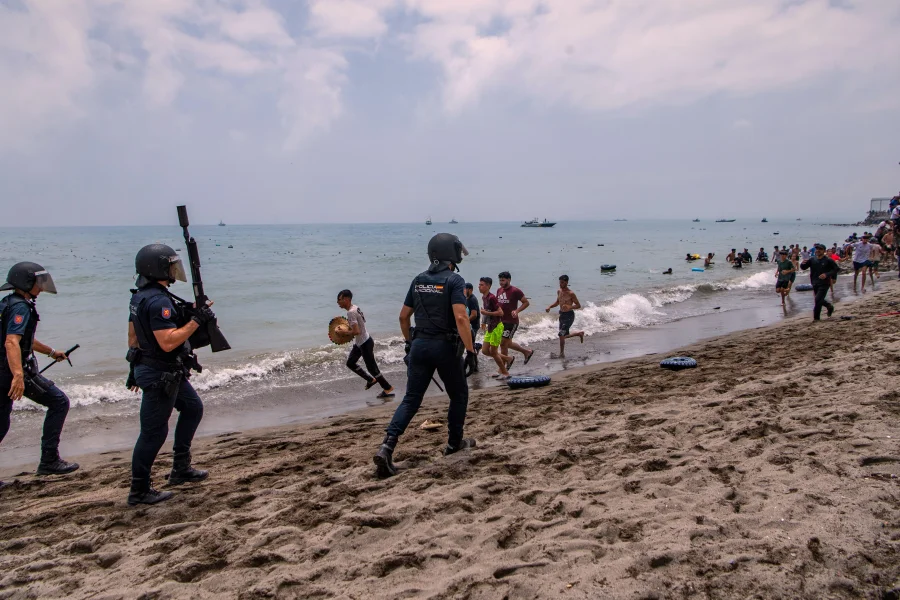
The waters off Ceuta’s Tarajal boundary have become a graveyard. At least 10 people have died trying to swim from Morocco into the Spanish enclave, as a new wave of migration overwhelms border forces.
Police sources confirmed to Spanish media that security personnel have recovered ten bodies so far. The death toll may rise as rescue operations continue.
Why thousands are attempting the sea route
The crossing from Morocco to Ceuta — a 22-kilometre swim along a dangerous coastline — has turned into a desperate dash. Young men and women, reportedly from sub-Saharan Africa and elsewhere, are taking the risk after land border barriers were reinforced. The Tarajal area, where the Mediterranean meets the Atlantic, is notorious for strong currents and cold water.
Army deployment signals severity
Spain’s government has decided to mobilise Army units to reinforce the Guardia Civil, which is described as “overwhelmed” by the scale of the arrivals. The military will assist in surveillance, rescue, and crowd control — a step not taken lightly and indicating the gravity of the situation.
Yesterday’s echoes: 2021 crisis comparison
The current crisis recalls May 2021, when an estimated 5,000 Moroccan citizens poured across the border in a single day after diplomatic tensions between Madrid and Rabat eased. That incident led to a humanitarian emergency in Ceuta’s streets. This time, the numbers are building over a week, and the result is again scenes of exhaustion and tragedy.
Who is affected and how
Ceuta, a city of around 85,000 people, has limited infrastructure to absorb large migrant flows. Residents report seeing bodies washed ashore, while local NGOs plead for medical support and basic supplies. The migrants themselves risk hypothermia, drowning, and injury from rocks. Families in Morocco and in sending countries wait in anguish for news.
Official response and political travel
Prime Minister Pedro Sánchez will travel to Ceuta tomorrow, accompanied by Interior Minister Fernando Grande-Marlaska. The visit is intended to assess the situation and coordinate a response. Brussels has already signalled the EU’s readiness to assist, reflecting the bloc’s broader concern about southern border pressures.
What this wave means for Spain and Europe
The surge underlines the persistent vulnerability of Spain’s North African enclaves. Ceuta and Melilla are the only land borders between Africa and the European Union, making them flashpoints for migration. The latest deaths reignite debate over EU migration policy, border security, and humanitarian obligations.
Confirmed facts vs what remains unclear
Confirmed: At least 10 bodies recovered; thousands attempting sea crossing; Army units mobilised; PM and minister visiting tomorrow.
Unclear: Exact nationalities of those who died; how many are still missing; whether Moroccan authorities are cooperating actively; the trigger for this particular wave.
Risks and balanced view
Spanish authorities face criticism both for insufficient sea rescue capacity and for potential pushbacks. Human rights groups have previously accused Spain of illegal “hot returns” at the border. On the other hand, the army deployment may save lives if focused on rescue, but could also signal a securitised response.
Broader migration pattern along the western Mediterranean
This incident is part of a larger trend. In 2023, more than 55,000 irregular migrants arrived in Spain by sea, according to Frontex. The Atlantic and Mediterranean routes remain deadly: nearly 1,000 people died attempting the Canary Islands route alone. The Ceuta tragedy fits a grim pattern where desperation meets geography.
What migrants, families, and humanitarian groups should know
For those considering the sea crossing: the risk of death is very high, even for strong swimmers. NGOs in the region offer legal advice, food, and shelter to survivors. Families in home countries can contact the Red Cross’s Restoring Family Links program. Spanish authorities advise that asylum applications can be filed at the border, though processing is often slow.
What happens next
PM Sánchez’s visit will likely produce short-term measures: more rescue boats, temporary shelters, and diplomatic talks with Morocco. The EU may offer financial support for border management and return agreements. Longer-term, the structural drivers — poverty, conflict, climate change — will persist unless addressed multilaterally.
Our Take
Ten lives lost in the attempt to reach European soil is a number that demands more than a news cycle. Behind each death is a story of aspiration, often misled by smuggler promises. The Spanish response — army deployment, high-level visit — is necessary but reactive. Without addressing the root causes in West Africa and the Sahel, the bodies will keep washing up on Ceuta’s shore. This is not a Spanish problem alone; it is Europe’s moral and political test.
Frequently Asked Questions
What caused the deaths in Ceuta?
At least ten people drowned while attempting to swim from Morocco into the Spanish enclave of Ceuta. Strong currents, cold water, and exhaustion are likely factors. Security forces recovered the bodies.
Why is Spain deploying the army to Ceuta?
Spain’s government mobilised Army units to support the Guardia Civil, which is overwhelmed by thousands of migrants trying to cross the sea border. The military will assist with surveillance, rescue, and order.
Has Ceuta seen this kind of crisis before?
Yes, a similar surge occurred in May 2021 when about 5,000 Moroccans crossed the land border in one day. The current wave has been building for a week and is now causing fatalities.
What is the European Union doing about it?
Brussels has expressed readiness to support Spain. The EU’s border agency Frontex may be deployed, and discussions on migration policy renewal are expected. No concrete assistance has been announced yet.