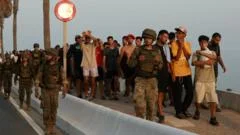
A surge of migrant crossings into Ceuta has done more than test a border. According to the BBC's Sarah Rainsford, the events at Spain's North African enclave have shaken Europe politically — exposing fault lines over migration that no summit has managed to close. At the centre of the escalating standoff is the role of social media, which Rainsford says has whipped the crisis into a full-blown political storm.
Ceuta: the border post that became a European flashpoint
Ceuta is one of two Spanish territories on Africa's northern coast, sharing a direct land border with Morocco. That geography makes every movement of people across its frontier instantly visible — and instantly political. The latest crossings have turned that border into a symbol of Europe's unresolved migration dilemma.
Why these crossings hit harder than earlier ones
Migration events at Europe's southern edges are not new. What made this moment different, the BBC analysis suggests, is how quickly the human movement became a political event. The Ceuta crossings did not just strain border arrangements; they reignited arguments among European governments about responsibility — arguments that have fractured the bloc for years.
The social media effect: a crisis whipped into a storm
Rainsford's reporting points to social media as a decisive accelerant. Reactions and political posts travelled across platforms faster than any official account could frame events, pushing the Ceuta crossings from a border story to a continent-wide political battleground. The BBC's account describes the storm as one whipped up online, where the political temperature rose with every share.
Europe's migration divide, exposed all over again
The fallout from Ceuta has reopened familiar divisions. European governments have long disagreed over how to share responsibility for people arriving at the continent's edges. The BBC's analysis says the crossings laid those divisions bare, leaving leaders confronted with a debate they have repeatedly failed to settle.
Confirmed facts versus what remains unclear
Confirmed in the BBC report: migrant crossings took place at Ceuta; the events have shaken European politics; divisions over migration policy were exposed; social media played a central role in amplifying the political storm; the account is by BBC correspondent Sarah Rainsford.
Not yet clear: the exact number of people involved, the specific responses of individual governments, and the timing of any official policy moves. None of these details appear in the available source material. Any claim about them would be speculation, not reporting.
What the Ceuta crisis could mean next
The ripple effects are still unfolding. If the pattern of past migration flashpoints holds, the divisions exposed at Ceuta could resurface in European discussions on asylum rules and border policy. But with official positions unconfirmed, any prediction of what happens next is exactly that — a prediction, not a reported fact.
Our Take
Ceuta is a reminder that migration crises are now fought on two fronts: the physical border and the information ecosystem. The same event can be framed as a humanitarian emergency, a security threat or a political provocation — and social media increasingly decides which frame wins. The challenge for European leaders, and for citizens trying to make sense of it all, is to separate the human reality from the amplified noise.
Frequently Asked Questions
What happened at Ceuta?
A surge of migrant crossings into Ceuta, a Spanish enclave on Africa's northern coast, triggered a major political crisis in Europe. The BBC's Sarah Rainsford reports that the events shook European politics and exposed divisions among governments over migration.
Why did the Ceuta crossings cause a political storm?
Migration is one of Europe's most politically sensitive issues. The crossings forced governments to confront their differing positions on who should take responsibility for people arriving at the continent's borders, and the fallout spread quickly across the European political landscape.
What role did social media play in the crisis?
According to the BBC's reporting, social media was a central force whipping up the political storm around the crossings. Political reactions and posts spread rapidly online, intensifying the crisis and turning it into a continent-wide battleground.
Where is Ceuta and why does it matter for migration?
Ceuta is one of two Spanish territories located on the northern coast of Africa, sharing a direct land border with Morocco. Because it sits on the European Union's external border, any crossings there immediately become a test of Europe's migration policy.