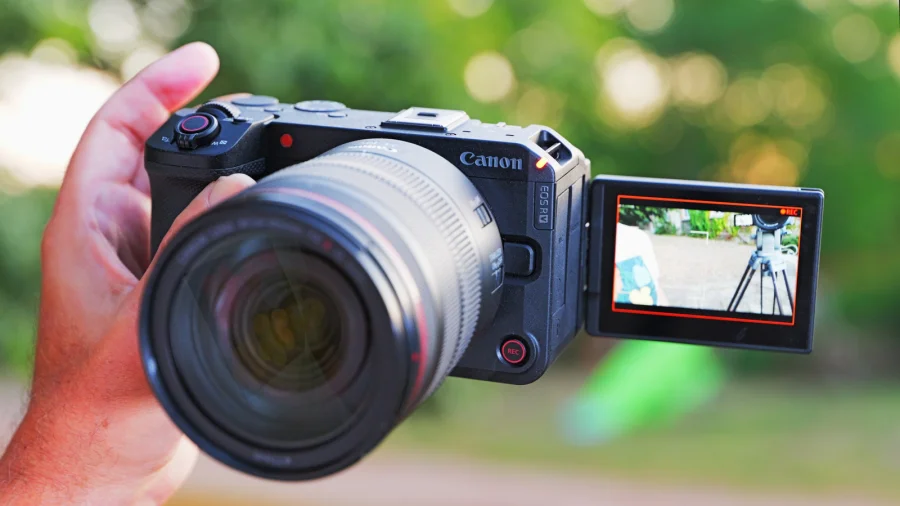
If you’ve been searching for a camera that treats video as a first-class citizen without demanding a cinema rig budget, Canon’s EOS R6 V might be the answer. The company has taken the DNA of its popular R6 series and tuned it — almost exclusively — for the needs of vloggers, streamers, and solo filmmakers. The result is a hybrid that feels purpose-built for the creator economy.
Video-first design without the cinema price
The R6 V is essentially a video-optimised variant of the EOS R6 II, but Canon has made deliberate trade-offs. You get robust 4K recording at up to 60 fps with no crop, extended recording limits, and improved heat dissipation that allows continuous shooting for hours. The body retains the familiar ergonomics and dual card slots, but the firmware is tuned for video workflows — including focus breathing correction and zebra patterns for exposure.
Why vloggers will love the autofocus and stabilisation
Canon’s Dual Pixel CMOS AF II is widely considered the best in the business for video. The R6 V inherits that system with enhanced subject tracking for humans and animals. Combined with 5-axis in-body stabilisation, handheld walking shots remain smooth. For a vlogger this means fewer reshoots and more time creating.
Who is the Canon EOS R6 V really for?
This camera is not aimed at sports photographers or landscape shooters. It is designed explicitly for creators who need consistent video quality, reliable autofocus, and clean audio input (including a microphone jack and headphone monitoring). Solo YouTubers, travel vloggers, and even small production teams will find it a capable B-cam or main shooter.
Trade-offs: what you lose compared to the R6 II
While the video features are excellent, the R6 V downgrades some still-photography capabilities — such as a lower burst rate and a simpler viewfinder. Photographers may prefer the standard R6 II. Canon has also opted out of raw video output, a choice that may disappoint advanced users but keeps the price accessible.
Competition and market positioning
The EOS R6 V enters a crowded segment. Sony’s ZV-E1 offers a full-frame sensor and AI-based framing at a similar price, while Panasonic’s S5 IIX provides ProRes recording. Canon’s edge lies in its colour science and lens ecosystem — the RF mount now has a solid range of affordable glass, especially the f/1.8 primes that vloggers favour.
Risks and balanced view
Early adopters should watch for potential overheating during extended 4K 60p recording in warm environments, though Canon claims improvements over previous models. The lack of a fully articulating screen (the R6 V uses a vari-angle design) may be a minor annoyance for front-facing vlogging. Also, the price — while lower than cinema cameras — is still premium compared to APS-C options.
Wider trend: cannibalising the cinema line
Canon’s strategy with the R6 V reflects a broader industry shift: the line between mirrorless cameras and dedicated camcorders is blurring. Brands are realising that the creator market wants pro tools at consumer budgets. The R6 V is a calculated bet that vloggers will pay extra for reliable video features if they don’t have to learn a whole new ecosystem.
Practical guidance for potential buyers
If you are a still photographer first, stick with the R6 II. But if your primary output is video and you want a camera that works out of the box for vlogging, the EOS R6 V deserves a close look. Pair it with the RF 24mm f/1.8 or 35mm f/1.8 lens for a lightweight, cinematic vlogging kit.
Future outlook
Canon is likely to iterate on this concept, potentially adding RAW output or higher frame rates in later firmware updates. However, as the creator economy grows, we can expect more manufacturers to offer video-first models. The R6 V sets a strong baseline.
Our Take
The Canon EOS R6 V is not a revolution but a smart evolution — taking proven hardware and tuning it for a specific, growing audience. It recognises that today’s best vlogging tool is not a camcorder or a smartphone, but a full-frame camera that gets out of your way and lets you focus on the story. For creators earning from their videos, the investment makes sense.
Frequently Asked Questions
Is the Canon EOS R6 V good for live streaming?
Yes. It offers clean HDMI output, UVC/UAC support, and reliable autofocus, making it an excellent webcam replacement or dedicated streaming camera.
Does the EOS R6 V overheat during long recordings?
Canon has improved heat management with a redesigned heatsink. Most reviewers report no overheating during standard 4K 30p recording for over an hour, but 4K 60p may cause shutdown in hot conditions.
What lenses are recommended for vlogging with the R6 V?
The RF 24mm f/1.8 IS STM and RF 35mm f/1.8 IS STM are lightweight, offer stabilisation, and provide a natural field of view for handheld vlogging.
How does the EOS R6 V compare to the Sony ZV-E1?
The ZV-E1 has a larger sensor (full-frame) and AI-based autofocus features, but the R6 V has superior colour science and a more robust lens ecosystem. Choice depends on whether you prioritise Sony’s software tricks or Canon’s reliable output.