
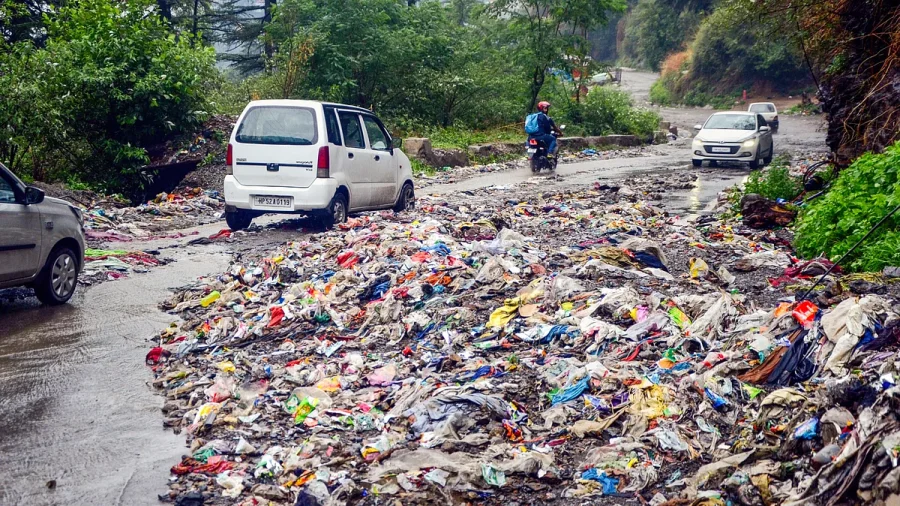
One street, two standards. The same person who carefully finds a dustbin in Singapore or Tokyo can toss a wrapper onto a Mumbai road without a second thought. It is a habit millions recognise — but hearing it questioned from a Bombay High Court bench, on a day the court was examining the toxic reality of Kanjurmarg dumping ground, gave the frustration legal weight.
Why the court called out the 'double standard'
Hearing petitions on pollution, foul odour, gas emissions and health hazards around the Kanjurmarg dumping ground, the bench of Justices G.S. Kulkarni and Aarti Sathe raised a direct question. Many people, the court observed, strictly follow cleanliness rules abroad but disregard them in India. The message was pointed: civic discipline cannot be a tourist habit.
Kanjurmarg: the case behind the courtroom remark
This was not abstract moralising. The remarks came during litigation over one of Mumbai's most contentious waste sites, where residents have long complained of unbearable stench, smoke and recurring health problems. The court was connecting individual behaviour to a civic emergency unfolding next door to people's homes.
'A corresponding fundamental duty' — what the bench said
The court stressed that a clean environment comes with responsibility attached. "If a person wants a clean environment, then he or she has a corresponding fundamental duty towards the society to maintain cleanliness," the bench said. It called for strict enforcement against violators and said both citizens and civic officials need sensitisation to keep public roads and spaces free of garbage.
Who actually pays the price of litter
The people who suffer most are rarely the ones dropping the waste. Communities living near dumping grounds breathe polluted air, endure constant foul odour and face serious long-term health risks. The court's remarks underline that littering is not a minor civic nuisance — its cost lands hardest on those living beside the city's waste infrastructure.
What the bench told civic officials
Citizens were not the only target. The court indicated that civic officials, too, need sensitisation — an acknowledgement that enforcement has been selective or absent. Cleanliness, the bench insisted, is a shared responsibility, not a burden that belongs only to the municipal corporation.
Reading between the lines: attitude, not infrastructure
The crux of the court's observation is that India's garbage problem is not simply missing dustbins or underfunded municipalities. The same citizens manage spotless environments abroad without special training — they respond to stricter social and legal consequences. The contrast, the court suggested, is a choice, not a capability gap.
What is confirmed and what is still unclear
Confirmed: the bench made these remarks on Friday, 31 July while hearing pleas on Kanjurmarg; it demanded strict enforcement and sensitisation of citizens and officials. Unclear: the full text of the court's observation — the reported quote ends mid-sentence at "We want..." — and any specific timelines or directions set for the next hearing. Those details will emerge from the official order.
The civic reality check
A balanced view demands honesty about infrastructure gaps too. In many Indian cities, dustbins are scarce, waste collection is irregular and dumping grounds operate far beyond capacity. Enforcement alone may not break the habit if reliable municipal service is missing. The court itself acknowledged that officials, not just citizens, must change.
Beyond Kanjurmarg: a pattern across Indian cities
Kanjurmarg is not an isolated case. Indian cities have repeatedly seen disputes over landfill sites — complaints of toxic smoke, groundwater contamination and illness in neighbouring settlements. The Bombay High Court's observation turns a Mumbai-specific case into a national commentary on how public spaces in India are treated as disposable.
What citizens can do right now
Start with the small test the court described: behave the way you do abroad. Use the dustbin, carry waste back if none is found, stop throwing garbage from vehicles and report overflowing collection points to local ward offices. Residents near dumping grounds should document violations — photographs, dates, locations — and file written complaints. Such records strengthen petitions like those before the court.
Where the case goes from here
The hearing is ongoing. The bench has laid down a clear principle — cleanliness is a fundamental duty, and enforcement must follow. Whether that translates into specific orders, a remediation timeline for Kanjurmarg or penalties for violators remains to be seen.
Our Take
This observation matters beyond Kanjurmarg because it names a truth most Indians recognise in private but rarely hear in court: our public behaviour shifts with the fear of consequences. The High Court has now placed that on record.
