Summary
Archaeologists working in the ancient city of Pompeii have uncovered evidence of a remarkable military invention. They found traces of what is often called the world’s first "machine gun," a repeating weapon known as the polybolos. This device allowed ancient soldiers to fire multiple arrows one after another without stopping to reload by hand. The discovery provides a rare look at the high level of engineering and technology used by the Roman military before the eruption of Mount Vesuvius.
Main Impact
The discovery of this weapon changes how historians think about ancient combat. For a long time, many people believed that rapid-fire weapons were a modern invention. However, this find proves that the Romans and Greeks had mastered complex mechanical systems over 2,000 years ago. By finding these traces in Pompeii, researchers now have physical proof that these advanced machines were not just ideas in old books but were real tools used in the field. This highlights the Roman Empire's focus on technical superiority and military strength.
Key Details
What Happened
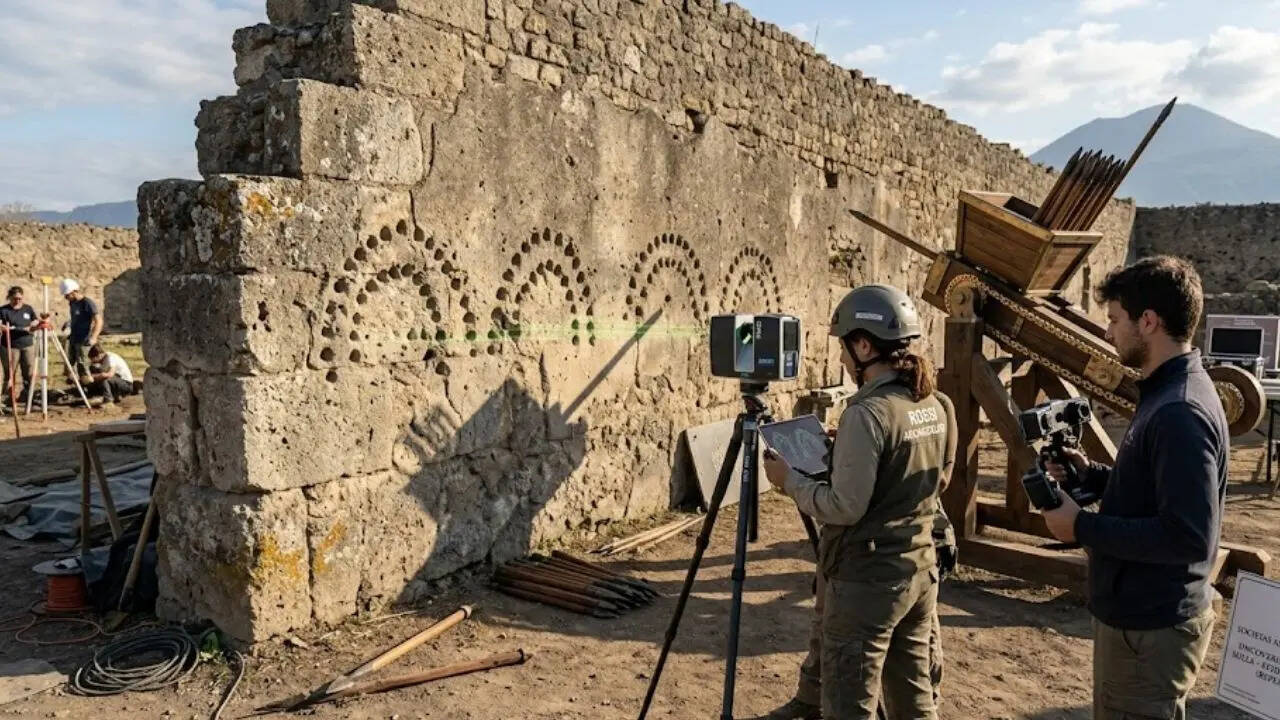
During a recent dig in the famous ruins of Pompeii, experts identified metal parts and mechanical remains that did not fit standard tools or furniture. After careful study, they realized these parts belonged to a polybolos. This was a type of repeating catapult. Unlike a normal bow or a standard catapult that requires a soldier to place a new arrow for every shot, the polybolos used a magazine and a chain drive. This allowed the weapon to feed arrows into the firing slot automatically as the operator turned a winch.
Important Numbers and Facts
The polybolos was originally designed by a Greek engineer named Dionysius of Alexandria in the 3rd century BCE. It was later improved by other inventors like Philon of Byzantium. The weapon used a flat-link chain, which is considered one of the earliest uses of such technology in human history. While a standard archer might fire a few arrows a minute, a polybolos could fire much faster and with greater accuracy because the weapon stayed aimed at the same target during the reloading process. The traces found in Pompeii date back to the time of the city's destruction in 79 AD, showing the weapon was still relevant centuries after its invention.
Background and Context
Pompeii is a unique place for archaeologists because the volcanic ash from Mount Vesuvius acted like a preservative. When the volcano erupted, it covered the city quickly, freezing everything in time. This is why we can find delicate items and complex machines that have rotted away in other parts of the world. The polybolos represents the peak of ancient "ballistics," which is the science of firing projectiles. In the ancient world, having a weapon that could fire repeatedly gave an army a huge advantage during a siege or when defending a city wall. It was the high-tech hardware of its day.
Public or Industry Reaction
The scientific community is very excited about this find. Many historians previously thought the polybolos was too complicated to be used in actual battles. They believed it might have been a "showpiece" or a prototype that never saw real action. However, finding evidence of it in a busy city like Pompeii suggests it was a practical part of the Roman military's equipment. Engineering experts are also interested in the chain mechanism, as it shows that ancient people had a very deep understanding of gears and motion, much earlier than previously thought.
What This Means Going Forward
This discovery will likely lead to a re-examination of other metal fragments found in Roman military camps across Europe and North Africa. Now that researchers know what to look for, they may find that these repeating weapons were more common than we realized. It also opens up new opportunities for museums to create working models of these ancient machines. By studying how the polybolos was built, modern engineers can learn more about the materials and methods used by ancient craftsmen to create high-pressure mechanical systems without modern power tools.
Final Take
The "machine gun" of Pompeii is a powerful reminder that ancient civilizations were far more advanced than we often give them credit for. The people of the Roman era were not just builders of roads and temples; they were also masters of mechanical engineering. This discovery brings a legendary weapon out of the history books and into the real world, showing us that the drive to create faster and more efficient technology has been part of the human story for thousands of years.
Frequently Asked Questions
What is a polybolos?
A polybolos is an ancient repeating catapult that could fire multiple arrows in a row using a chain-driven loading system and a wooden magazine.
How did the ancient machine gun work?
It worked by turning a winch that moved a chain. This chain pulled the bowstring back, dropped an arrow from a storage box into the firing groove, and then released the string to fire the arrow.
Why is this discovery in Pompeii important?
It is important because it provides physical evidence that these complex weapons were actually built and used, rather than just being theoretical designs mentioned in ancient texts.