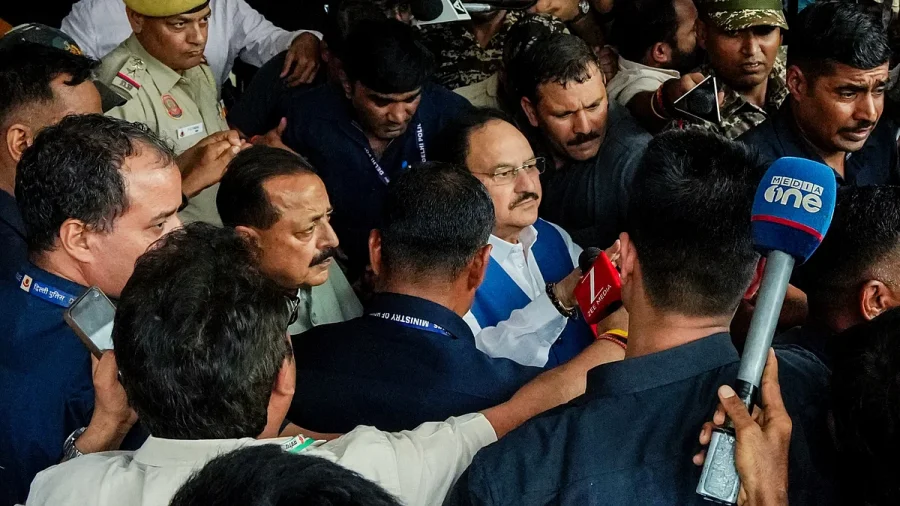
The clock is ticking for Union education minister Dharmendra Pradhan. The Cockroach Janta Party (CJP), a youth-led protest group, has hardened its stance and issued a 24-hour ultimatum for his resignation after a nearly two-hour meeting with government representatives on Friday failed to yield any progress on their core demand.
Talks at neutral venue signal shift in government approach
In a politically significant departure from previous rounds, the meeting was held at the Constitution Club of India (CCI) instead of the residence of Union minister and former BJP president J.P. Nadda. Political observers view this shift to a neutral venue as a sign that the government is willing to engage on more equal terms, even as differences over Pradhan’s resignation remain unresolved.
Why Pradhan’s resignation is the sticking point
The CJP has made the education minister’s exit its principal demand, accusing him of failing students and the youth. The group’s spokesperson, Saurav Das, said after the meeting that the government’s refusal to budge on this issue has left them with no choice but to escalate. “We gave them time. Now we are giving them 24 hours,” Das told reporters outside the Constitution Club.
What happened during the two-hour meeting
The talks, described by sources as “intense but civil,” saw both sides present their positions. Government representatives reportedly offered to address other grievances but refused to entertain the resignation demand. The CJP delegation walked out without a deal, but both sides agreed to meet again on Saturday, 25 July, to continue negotiations.
Who is affected by this standoff
Students, parents, and youth across India are watching closely. The CJP claims to represent a broader frustration with the education system and government policies. If the deadline passes without Pradhan’s resignation, the group has hinted at larger protests that could disrupt normal life in Delhi and beyond.
Government’s response and next steps
Government representatives have not publicly commented on the ultimatum. However, sources indicate that the Centre is keen to avoid a prolonged confrontation, especially with the youth vote being a critical constituency. The Saturday meeting is seen as a last-ditch effort to find a compromise before the deadline expires.
What the shift to Constitution Club means politically
The choice of the Constitution Club—a neutral, historic venue—over a political leader’s residence is being read as a tactical move. It suggests the government is treating the CJP as a serious negotiating partner rather than dismissing the protest as fringe. This could embolden other youth groups to adopt similar tactics.
Confirmed facts vs what remains unclear
Confirmed: The meeting lasted nearly two hours at the Constitution Club of India. CJP has set a 24-hour deadline for Pradhan’s resignation. Next talks are on Saturday. Unclear: Whether the government will concede to the demand, or what form escalation might take. The exact number of CJP members involved and any internal divisions within the group remain speculative.
Risks and balanced view
While the CJP’s demand has resonated with some youth, critics argue that targeting a single minister oversimplifies systemic education issues. Others worry that a hardline stance could lead to unrest or police action. The government faces a delicate balancing act: appearing responsive without setting a precedent for resignation-by-protest.
Wider trend of youth-led protests in India
This standoff is part of a broader pattern of youth-led movements in India, from anti-CAA protests to student fee agitations. The CJP’s tactics—deadlines, neutral venues, media-savvy spokespersons—mirror strategies seen in recent campus movements, suggesting a new playbook for holding power accountable.
What students and observers should watch for
For those following the story, the key date is Saturday, 25 July. If the meeting produces a breakthrough, the crisis may de-escalate. If not, expect the CJP to announce further actions—possibly a march, sit-in, or call for a broader strike. Parents and students in Delhi should stay informed about potential disruptions.
Future outlook: What could happen next
Three scenarios are plausible: a last-minute compromise where Pradhan offers to address grievances without resigning; a partial concession where the government agrees to a review or inquiry; or a full-blown protest if the deadline is ignored. The outcome will likely shape how future youth movements engage with the government.
Our Take
This is more than a single minister’s fate. The CJP’s 24-hour deadline tests whether India’s political system can absorb youth anger through dialogue or will default to confrontation. The shift to a neutral venue is a small but meaningful step. But if Saturday’s talks fail, the real question is not just about Pradhan—it’s about whether the government can rebuild trust with a generation that feels unheard.
Frequently Asked Questions
What is the CJP demanding?
The Cockroach Janta Party (CJP) is demanding the resignation of Union education minister Dharmendra Pradhan, accusing him of failing students and the youth.
Why did talks fail on Friday?
The nearly two-hour meeting at the Constitution Club of India failed because the government refused to accept the resignation demand, while the CJP refused to drop it.
When is the next meeting?
The next round of talks is scheduled for Saturday, 25 July, at the same venue—the Constitution Club of India.
What happens if the deadline is not met?
The CJP has threatened to escalate protests, possibly with larger demonstrations or disruptions, if Pradhan does not resign within 24 hours.